जेव्हा तुझ्या एकटेपणाला समज़ून घेण्याची मनोज्ञता मी हरवून बसतो,
तेव्हा मी अनुभवतो मला एका अपराध्याच्या पिंज़र्यात,
तो पिंज़रा ज्याचं नाव आहे शहाणपण, व्यवहार,
पण मग मी करू तरी काय?
मी आहे तितकाच हतशक्त या पिंज़र्याच्या भयाणतेने,
बाहेर पडावं तर वेड आणि अव्यवहार्यतेचे सापळे आहेत
आत रहावं तर शहाणपण आणि व्यवहार्यतेचे अपराधीपण...!
-------------------------
Thursday, August 06, 2009

Friday, June 19, 2009
देरिदा प्रेम आणि सत् यांवर...
देरिदाचा हा एक वीडियो:
http://www.youtube.com/watch?v=dj1BuNmhjAY&feature=related
यात तो प्रेम (LOVE) आणि सत् (BEING) यावर बोलत आहे. बोलत प्रेम यावर आहे पण त्याचा संबंध सत् शी कसा आहे ते ओघाने आले आहे. ज़रूर बघावा असा आहे. तो जे म्हणत त्यातील काही भाग, पद्यात(?) साररूपाने असा:
माझे तुझ्यावर प्रेम आहे असे म्हणतो जेव्हा मी
तेव्हा मी एकमेव, अद्वितीय अशा तुझा
विचार करीत असतो असं मला वाटतं खरं
पण कालौघात मला असं कळतं की तुझ्यातले जे
गुण मला प्रिय होते त्यांना मी तू मानत होतो,
आता जेव्हा मला काही अन्य गुण कळतात, किंवा
अजिबातच सापडत नाहीत तेव्हा मी म्हणतो की
माझं तुझ्यावर प्रेम नाही,
पण मी जेव्हा म्हणालो माझं तुझ्यावर प्रेम आहे,
तेव्हा त्याचा अर्थ तो नव्हताच
आणि आज़ जेव्हा मी म्हणतो माझं तुझ्यावर प्रेम नाही
तेव्हा त्याचा अर्थ तो नाहीच!
ज़रा गद्यात्मक सार असा:
ज्ञाता (knower) आणि ज्ञेय (knowee, the thing that is being known) यातील संबंधाला ज्ञान म्हणतात. वस्तुतः ते असत नाही तेव्हा एखादी गोष्ट ‘आहे’ म्हणजे त्या संबंधाने असते. त्या संबंधाशिवाय असत नाही. आपण ज्याला असणे समज़तो ते इतकेच असते पण आपण त्याला objectively अस्तित्वात आहे असे समज़त असतो। interestingly the problem of BEING and LOVE is the same. The only difference: in love, we believe qualities to be individual. BEING मध्ये what (काय=ज्ञेय) आणि who (कोण=ज्ञाता) असे दोन प्रश्न असतात प्रेमातही तेच काय=गुण, कोण=व्यक्ती. थोडक्यात:
सत् किंवा अस्तित्व किंवा BEING चे जे प्रश्न आहेत किंवा गूढ आहे तेच प्रेमाचे आहे फरक असा की आपल्याला ज्ञानाची ( ज्ञातृत्वामुळे ज्ञान होण्याची) आणि (सत्त्वामुळे) असण्याची इतकी सवय झालेली असते किंवा तेच आपले असणे असते, त्यामुळे त्याची ज़ाणीव तशी तटस्थ होत नाही. पण, प्रेम आपण काळात सुरु होतांना आणि संपताना अनुभवतो म्हणून व्यथित किंवा आनंदी होतो.
-------------------------------------------------------------------------------------------------
http://www.youtube.com/watch?v=dj1BuNmhjAY&feature=related
यात तो प्रेम (LOVE) आणि सत् (BEING) यावर बोलत आहे. बोलत प्रेम यावर आहे पण त्याचा संबंध सत् शी कसा आहे ते ओघाने आले आहे. ज़रूर बघावा असा आहे. तो जे म्हणत त्यातील काही भाग, पद्यात(?) साररूपाने असा:
माझे तुझ्यावर प्रेम आहे असे म्हणतो जेव्हा मी
तेव्हा मी एकमेव, अद्वितीय अशा तुझा
विचार करीत असतो असं मला वाटतं खरं
पण कालौघात मला असं कळतं की तुझ्यातले जे
गुण मला प्रिय होते त्यांना मी तू मानत होतो,
आता जेव्हा मला काही अन्य गुण कळतात, किंवा
अजिबातच सापडत नाहीत तेव्हा मी म्हणतो की
माझं तुझ्यावर प्रेम नाही,
पण मी जेव्हा म्हणालो माझं तुझ्यावर प्रेम आहे,
तेव्हा त्याचा अर्थ तो नव्हताच
आणि आज़ जेव्हा मी म्हणतो माझं तुझ्यावर प्रेम नाही
तेव्हा त्याचा अर्थ तो नाहीच!
ज़रा गद्यात्मक सार असा:
ज्ञाता (knower) आणि ज्ञेय (knowee, the thing that is being known) यातील संबंधाला ज्ञान म्हणतात. वस्तुतः ते असत नाही तेव्हा एखादी गोष्ट ‘आहे’ म्हणजे त्या संबंधाने असते. त्या संबंधाशिवाय असत नाही. आपण ज्याला असणे समज़तो ते इतकेच असते पण आपण त्याला objectively अस्तित्वात आहे असे समज़त असतो। interestingly the problem of BEING and LOVE is the same. The only difference: in love, we believe qualities to be individual. BEING मध्ये what (काय=ज्ञेय) आणि who (कोण=ज्ञाता) असे दोन प्रश्न असतात प्रेमातही तेच काय=गुण, कोण=व्यक्ती. थोडक्यात:
सत् किंवा अस्तित्व किंवा BEING चे जे प्रश्न आहेत किंवा गूढ आहे तेच प्रेमाचे आहे फरक असा की आपल्याला ज्ञानाची ( ज्ञातृत्वामुळे ज्ञान होण्याची) आणि (सत्त्वामुळे) असण्याची इतकी सवय झालेली असते किंवा तेच आपले असणे असते, त्यामुळे त्याची ज़ाणीव तशी तटस्थ होत नाही. पण, प्रेम आपण काळात सुरु होतांना आणि संपताना अनुभवतो म्हणून व्यथित किंवा आनंदी होतो.
-------------------------------------------------------------------------------------------------
Friday, March 23, 2007
Nominalization in Marathi
Nominalization in Marathi
Chinmay Dharurkar
Definition and scope of the term:
Nominalization proper means "turning something into a noun"(Comrie & Thompson 1985) and refers to the corresponding processes
or operations and to their results.
Nominalisation covers a broad range of transposiational phenomena, where transposition in turn refers to word-class-changing operations
(Haspelmath, 2002)
Often applied without clear criteria and definitions the term [nominalisation] is grossly misused.
A clear definition of nominalisation and any serious attempts to approach them cross-linguistically should take into account at the least the following parameters:
1. What expression types are turned into a noun?
2. What are the meanings of the resulting expressions?
3. In what sense is the resulting expression noun?
4. Is the process derivational or inflectional?
5. Do the resulting expressions show mixed properties?
6. What are the functions of the resulting expressions?
With this much in the mind we will proceed to see how much productive is Nominalization in Marathi.
1.Verbal nouns: These are the nominalised forms of the verbs that are (under the influence of Sanskrit grammatical tradition) called krudanta nouns. Krudanta nouns in Sanskrit are formed as gam (to go)-gamana (going), bhASh (to speak)-bhAShaNa (speaking or speech) etc. These are also referred as ANs or action nouns.
This type of nominalization is very productive and the meaning of the resulting noun is predictable i.e. the act of V or way or manner of performing the action. Some examples of the type are as follows:
Verb Noun
1) zaa zaaNa
(to go) (going)
2) Ye yeNa
(to come) (coming)
3) zhop zhopNa
(to sleep) (sleeping)
4) vichaar vichaarNa
(to ask) (asking)
5) c^aav c^aavNa
(to bite) (biting)
Used in sentences:
1a)to gelaa he malaa paTla^ naahii.
He go-past this I-dat like-past neg.
I didn’t like that he went.
1b) tyaac^a zaaNa malaa paTla naahii
His going to me liked not
I did not like his going.
2a)to saarkhac^ hasto he c^aangla^ naahii.
He always laughs this good not is.
2b)Tyaac^a saarkha hasaNa^ c^aangla naahii.
His ever laughing good not is.
His laughing always is not good.
Each and every verb can undergo this kind of nominalization. One interesting point to note about these nouns is that these normally cant come in the main clause but nowadays there is tendency in languages like
Marathi, Hindi etc that these forms can be used in main clause position in back grounded portions of discourse. E.g. setting the scene or subsidiary information.
2. Agentive nouns: These are productive but are actually the future participle of the verbs. Or might be a co-incidence that the active future participle forms
And the agentive forms have the same phonological shape.
Some examples:
Zaa - zaaNaaraa
(to go) – goer
Ye - yeNaaraa
(to come) (comer)
Zhop- zhopNaaraa
(to sleep) (sleeper/one who sleeps)
Vichaar- vichaarNaaraa
(to ask) asker
C^aav- c^aavNaaraa
To bite biter
Such nominalisation is also highly productive.
3.Objective nouns: These are actually the passive forms of the above participles but are used as nouns. So also the process is equally productive except for the intransitive verbs.
Examples:
Vichaar- vichaarlaa zaaNaaraa
(to ask) (the one being asked)
Maar maarlaa zaaNaaraa
(to hit)- ( the one being hit)
4. Adjective to nouns:This is again a very productive one. All adjectives can be nominalised using this nominal suffix – paNaa. The meaning of the resultant expression is the property of or quality of being that.
Examples:
veDaa veDepaNaa
(mad) (madness)
aaLshii aaLshiipaNaa
(lazy) (laziness)
shahaaNaa shahaaNpaNaa
(wise) (wisedom)
Muurkha muurkhapaNaa
(foolish) (foolishness)
Naazuk naazukpaNaa
(tender) (tenderness)
Bahiraa bahirepaNaa
(deaf) (deafness)
Sopaa sopepaNaa
(easy) (easiness)
khoTaa koTepaNaa
(false) (falseness)
Lahaan lahaanpaNaa
(small) (smallness)
GoD goDpaNaa
(sweet) (sweetness)
And so on the process is productive. For Sanskrit loan words paNaa is also replaceable by the suffixes twa and taa.
Other nominalising suffixes are vaa (not much productive) found in:
goD goDvaa
(sweet) (sweetness)
Gaar gaarvaa
(cold) (coldness)
ii in :
Laayak laaykii
(eligible) (eligibility)
Laal laalii
(red) (redness)
goD goDii
(sweet) (sweetness) But not in other taste-words.
5. Nouns to nouns:
Common nouns are changed in abstract nouns by adding the suffix paN.
Not much productive. If we stretch it to all common nouns the resultant expression are possible but not found in the language and can be employed in philosophical debate in Nyaya system of Indian philosophy while discussing about jaati or category.
Examples:
maaNus - maaNuspaN
(man) (humanity)
Dev devpaN
(god) (godliness)
Replaceable by twa for Sanskrit loan words.
Also the suffix –ii acts nominalises a noun:
Maalak - maalkii
(owner) (ownership)
Gulaam - gulaamii
(slave) (slavery)
Naukar - naukrii
(servant) (service)
Praadhyaapak praadhyaapakii
(professor) (professorship)
Gaayak - gaaykii
(singer) (singing or type of singing)
ki in:
maastar - maastarkii
(master) (profession of Master)
paaTil - PaaTilkii
( a title for who owns or controls a village.)
References:
1) Brown K, (2006) Encyclopedia of Language & Linguistics, Elsever, London.
2) Chomsky, Noam. 1970. "Remarks on Nominalization." In: R. Jacobs and P. Rosenbaum (eds.), Readings in English Transformational Grammar, Ginn, Waltham, MA, 184-221.
3) Mathews, P.H (2003) Dictionary of Linguistics, OUP, London
Chinmay Dharurkar
Definition and scope of the term:
Nominalization proper means "turning something into a noun"(Comrie & Thompson 1985) and refers to the corresponding processes
or operations and to their results.
Nominalisation covers a broad range of transposiational phenomena, where transposition in turn refers to word-class-changing operations
(Haspelmath, 2002)
Often applied without clear criteria and definitions the term [nominalisation] is grossly misused.
A clear definition of nominalisation and any serious attempts to approach them cross-linguistically should take into account at the least the following parameters:
1. What expression types are turned into a noun?
2. What are the meanings of the resulting expressions?
3. In what sense is the resulting expression noun?
4. Is the process derivational or inflectional?
5. Do the resulting expressions show mixed properties?
6. What are the functions of the resulting expressions?
With this much in the mind we will proceed to see how much productive is Nominalization in Marathi.
1.Verbal nouns: These are the nominalised forms of the verbs that are (under the influence of Sanskrit grammatical tradition) called krudanta nouns. Krudanta nouns in Sanskrit are formed as gam (to go)-gamana (going), bhASh (to speak)-bhAShaNa (speaking or speech) etc. These are also referred as ANs or action nouns.
This type of nominalization is very productive and the meaning of the resulting noun is predictable i.e. the act of V or way or manner of performing the action. Some examples of the type are as follows:
Verb Noun
1) zaa zaaNa
(to go) (going)
2) Ye yeNa
(to come) (coming)
3) zhop zhopNa
(to sleep) (sleeping)
4) vichaar vichaarNa
(to ask) (asking)
5) c^aav c^aavNa
(to bite) (biting)
Used in sentences:
1a)to gelaa he malaa paTla^ naahii.
He go-past this I-dat like-past neg.
I didn’t like that he went.
1b) tyaac^a zaaNa malaa paTla naahii
His going to me liked not
I did not like his going.
2a)to saarkhac^ hasto he c^aangla^ naahii.
He always laughs this good not is.
2b)Tyaac^a saarkha hasaNa^ c^aangla naahii.
His ever laughing good not is.
His laughing always is not good.
Each and every verb can undergo this kind of nominalization. One interesting point to note about these nouns is that these normally cant come in the main clause but nowadays there is tendency in languages like
Marathi, Hindi etc that these forms can be used in main clause position in back grounded portions of discourse. E.g. setting the scene or subsidiary information.
2. Agentive nouns: These are productive but are actually the future participle of the verbs. Or might be a co-incidence that the active future participle forms
And the agentive forms have the same phonological shape.
Some examples:
Zaa - zaaNaaraa
(to go) – goer
Ye - yeNaaraa
(to come) (comer)
Zhop- zhopNaaraa
(to sleep) (sleeper/one who sleeps)
Vichaar- vichaarNaaraa
(to ask) asker
C^aav- c^aavNaaraa
To bite biter
Such nominalisation is also highly productive.
3.Objective nouns: These are actually the passive forms of the above participles but are used as nouns. So also the process is equally productive except for the intransitive verbs.
Examples:
Vichaar- vichaarlaa zaaNaaraa
(to ask) (the one being asked)
Maar maarlaa zaaNaaraa
(to hit)- ( the one being hit)
4. Adjective to nouns:This is again a very productive one. All adjectives can be nominalised using this nominal suffix – paNaa. The meaning of the resultant expression is the property of or quality of being that.
Examples:
veDaa veDepaNaa
(mad) (madness)
aaLshii aaLshiipaNaa
(lazy) (laziness)
shahaaNaa shahaaNpaNaa
(wise) (wisedom)
Muurkha muurkhapaNaa
(foolish) (foolishness)
Naazuk naazukpaNaa
(tender) (tenderness)
Bahiraa bahirepaNaa
(deaf) (deafness)
Sopaa sopepaNaa
(easy) (easiness)
khoTaa koTepaNaa
(false) (falseness)
Lahaan lahaanpaNaa
(small) (smallness)
GoD goDpaNaa
(sweet) (sweetness)
And so on the process is productive. For Sanskrit loan words paNaa is also replaceable by the suffixes twa and taa.
Other nominalising suffixes are vaa (not much productive) found in:
goD goDvaa
(sweet) (sweetness)
Gaar gaarvaa
(cold) (coldness)
ii in :
Laayak laaykii
(eligible) (eligibility)
Laal laalii
(red) (redness)
goD goDii
(sweet) (sweetness) But not in other taste-words.
5. Nouns to nouns:
Common nouns are changed in abstract nouns by adding the suffix paN.
Not much productive. If we stretch it to all common nouns the resultant expression are possible but not found in the language and can be employed in philosophical debate in Nyaya system of Indian philosophy while discussing about jaati or category.
Examples:
maaNus - maaNuspaN
(man) (humanity)
Dev devpaN
(god) (godliness)
Replaceable by twa for Sanskrit loan words.
Also the suffix –ii acts nominalises a noun:
Maalak - maalkii
(owner) (ownership)
Gulaam - gulaamii
(slave) (slavery)
Naukar - naukrii
(servant) (service)
Praadhyaapak praadhyaapakii
(professor) (professorship)
Gaayak - gaaykii
(singer) (singing or type of singing)
ki in:
maastar - maastarkii
(master) (profession of Master)
paaTil - PaaTilkii
( a title for who owns or controls a village.)
References:
1) Brown K, (2006) Encyclopedia of Language & Linguistics, Elsever, London.
2) Chomsky, Noam. 1970. "Remarks on Nominalization." In: R. Jacobs and P. Rosenbaum (eds.), Readings in English Transformational Grammar, Ginn, Waltham, MA, 184-221.
3) Mathews, P.H (2003) Dictionary of Linguistics, OUP, London
Sunday, February 04, 2007
Duals and Comparatives:An e-mail conversation
This is an e-mail conversation that I had with :
Chinmay to GSG & PD:
Sir,
I am trying to see some relation between
the duals and the existence of Comparative Degree form
in Indo-European languages.What is interesting is the fact that
though the modern Indo-European languages have lost the duals
some of them retain the Comparative forms e.g English,German etc.
The fact is true with the Indo-European alone.Dravidian Family never
had duals and nor the comparative forms.No wonder in that.
However Semitic languages had and still retain the dual forms
and never had the comparative forms morphologically independently formed.
So the Comparison is analytical as in Hindi,Marathi (save the very Sanskritised
bookish forms rarely used: sundartara,sundartama etc)
bookish forms rarely used: sundartara,sundartama etc)
So the relation between the duals and the comparative forms is
idiosyncratic to the Indo-European languages.
What I want to know form you is that if there is any other family
- languages of which have the duals and the comparative forms?
Chinmay.
GSG to me:
Dear Chinmay,
The facts, and the evidently non-random correlation between them seem
very interesting. This line of research may have a lot of promise. Try
posting your query on the Linguist List, so that linguists speaking
diverse languages get to see and respond to it. I myself do not have
that kind of encyclopediac knowledge.
Best, G.
Then on Gsg's suggestion I posted my doubt on linguist's list:
and what I got is as follows:
Prof.Foster to me:
Found it have I that your query has stayed unanswered. I was hoping that a panelist who knows more than I do about this might reply, but I will take a shot at it.
hotz, hotzage, hotzena, hotzege 'too cold'.
Hungarian, a FennoUgric language, uses a vowel harmonic -abb/ebb suffix on adjectives -- and nouns -- to form a comparative. Thus
Janos - NOM magas-abb mint Istvan-NOM. 'Janos tall-er than Istvan.'
An alternative form uses the harmonic suffix -nal/-nel on the noun that refers to the standard, as in
Janos magasabb Istvan-nal..
This suffix is the adessive case and means 'nigh unto, close to', so what the latter (there's a comparative with the -er suffix) sentence means literally is 'Janos is tall-er near to Istvan.'
Hungarian can also derive a comparative adjective from a noun with the -abb/ebb suffix. The noun meaning 'fox' is roka. The sentence Janos rokabb Istvanal. means literally 'Janos fox-er Istvan-next to [is].', i.e. 'Janos is foxier than Istvan.'
Now, I believe that comparative Uralicists have evidence to reconstruct this kind of system for *ProtoFinnoUgric, and possibly for *ProtoUralic. So it may have once been more widespread.
But the -tero suffix meaning 'opposite, alternate' is etymologically related to the comparatives of adjectives in some IE languages. In Greek and Indoiranian it came to mark the comparative degree, and in Irish Gaelic the equative degree, as in luath 'swift' but luathither 'as swift'. This suffix may be cognate with the -ed suffix in Welsh used for the equative degree, as in gwyn, gwynned, gwynnach, gwynnaf 'white, as white, whiter, whitest', but I do not know that it is.
U of Cincinnati
Department of Anthropology
University of Cincinnati, Ohio, USA
Chinmay to Foster:
Sir,
thank you so much for your edifying reply.
what I mean by:
"some relation between the duals and the comparative degree forms"
is:
Note that comparative form is nothing but a way to compare between two.
Why such special treatment by giving morphological (against analytical) suffixation in case of adjectives(Sanskrit:sundaratara,uttara,uttungatara etc.) or pronouns (anyatara,itara etc) for comparison between two?
Interestingly and obviously enough, such forms are found in the
languages-- Pro-to of which had duals....do u have any such example...when pro-to doesn't have duals but the modern developments of which have separate comparative form?( If so it is exceptionally interesting?)This is precisely what I mean by 'some relation'.To rephrase in other words:
Existence of morphologically affixed comparative forms for adjectives has direct relation with the existence of dual number for nouns.
Also if this is not jabbering of mine:
With this as a point of departure we can trace the evolution of
counting numbers from 1,2 and their traces left in existence of duals and/or comparative forms.
Kindly comment to this mail.
Kindly comment to this mail.
Thank you once again for your the reply to the query.
Chinmay Dharurkar,
M.A.Applied Linguistics
Centre for Applied Linguistics and Translation Studies,
Hyderabad Central University,
Hyderabad 500046,
India.
Foster to Chinmay:
Dear Mr. Dharurkar,
I'm still not sure I am following your questions or proposals, but I'll try. Comments are inserted below after what they are commenting on.
At 12:51 PM 1/23/2007, you wrote:
I'm still not sure I am following your questions or proposals, but I'll try. Comments are inserted below after what they are commenting on.
At 12:51 PM 1/23/2007, you wrote:
Sir,
thank you so much for your edifying reply.
what I mean by:
"some relation between the duals and the comparative degree forms"
is:
Note that comparative form is nothing but a way to compare between two.
But actually, in many languages the comparative and superlative are not formally distinguished in any way.
And what about other degrees of comparison, excessive, insufficientive, equative, superlative, absolutive ( e.g. outermost in English.).
And even so, that does not mean there has to be a morphological or syntactic relationship, either synchronically or diachronically (historically) between the two. Dual marks a noun. Comparision of adjectives is a rather different device.
Why such special treatment by giving morphological (against analytical) suffixation in case of adjectives(Sanskrit:sundaratara,uttara,uttungatara etc.) or pronouns (anyatara,itara etc) for comparison between two?
Well, that's like asking why Khoisan languages have clicks since others don't or why a few languages have VOS order when most others don't. In general, we don't know. Some things that are rare nonetheless do exist. We would like to know why but usually it is difficult or impossible to find out why. And remember that in science, why really means "how it came to be". But as I noted, morphological suffixation to form the comparative and superlative, and equative (Celtic) or excessive (Basque) is not confined to Indoeuropean languages. Hungarian and some other Ugric languages have it, Basque has it. It does seem to be confined to Europe and Western Siberia.
Interestingly and obviously enough, such forms are found in the
languages-- Pro-to of which had duals....do u have any such example...when pro-to doesn't have duals but the modern developments of which have separate comparative form?
No, I dont happen to have any such examples. But that does not mean that dual number and suffixed forms of adjectival comparison are related phenomena. Dual number is fairly widespread. A number of languages in several different language families have it or have had it. But special suffixed forms of adjectives for degrees of comparison is far less common than dual grammatical number. (Incidentally, I don't think Basque has a dual number, but whether it did in the past I dont know and doubt if anybody does.) So having dual number is certainly not a sufficient cause for a language to develop suffixed degrees of comparison. Proto Uralic and Proto Indoeuropean both apparently had dual number. But it has been lost in Modern Hungarian but the suffixation of adjectives is very much alive. The same is true for Indoeuropean languages -- the dual number is much more restricted and vestigial but in the languages that have a suffix showing degrees of adjectival comparison, it is very much alive and productive (English, Russian, German &c. ) So one is very suspicious of positing a relationship between dual number, much of which once was, and suffixed comparison of adjectives, which very much still is. One is particularly hesitant to posit such a relationship when the sample size of languages with suffixed comparison morpheme is so very small and geographically proximate. It's just not a big enough sample to build much of a theory on.
( If so it is exceptionally interesting?)This is precisely what I mean by 'some relation'.To rephrase in other words:
Existence of morphologically affixed comparative forms for adjectives has direct relation with the existence of dual number for nouns.
But you have to have evidence that there in fact is such a relationship. You dont have any such evidence that I can see. Or,if you have, it is very weak. You have two language families -- Indoeuropean and Uralic -- in which there was a grammatical dual and in which there is found morphological marking of degrees of comparison of adjectives -- not just the comparative degree, but other degrees too. But there are many languages in which grammatical dual is found. The only other language in which there are suffixes showing adjectival degrees of comparison that I know of is Basque. That's not enough of a sample rule out coincidence as a likely explanation.
Also if this is not jabbering of mine:
With this as a point of departure we can trace the evolution of
counting numbers from 1,2 and their traces left in existence of duals and/or comparative forms.
I'm sorry, I don't follow this at all. We can find out about the development of words for numerals in lots and lots of languages. The occurrence of particular forms of nouns with particular numeral words may be an indication that there was an old partitive in a previous stage of the language, an old dual, or some other phenomenon.
And keep in mind that a few languages have a grammatical trial or paucal (a few) number in addition to a dual and a plural.
Joseph F Foster
Link to submit a question to Ask A Linguist on linguist list:
http://linguist.emich.edu/ask-ling/index.html
Tuesday, January 23, 2007
बिन हाथों में हाथ लिये
कुछ नहीं चाहता हूं तुम से
बस्स आओ बैठें बात करेंगे
बिन हाथों में हाथ लिये
एक दूसरे के साथ रहेंगे
बस्स आओ बैठें बात करेंगे
बिन हाथों में हाथ लिये
एक दूसरे के साथ रहेंगे
ज्ञात है मुझ को अच्छा-
न तुम्हारी संवेदना का एकदशमांश हिस्सा भी मैं ले सकूंगा
न मेरी वेदना का अर्धभाग भी तुम ले सकोगी
न रिश्ता होगा न धोखे की व्यापारशृंखला जारी रहेगी
न स्पर्श,न भोग, न चुम्बन, न प्रतिजनन या मरण
कुछ नहीं चाहता हूं तुम से
बस्स आओ बैठें बात करेंगे
बिन हाथों में हाथ लिये
एक दूसरे के साथ रहेंगे
दो चार बातें तुम मुझ को नीजी सुना देना
कहना चाहो तो कह सकती हो जिन को अपने जीवन की
दो चार बातें मैं तुम को अपनी सुना दुंगा कह सकता हूं जिन को मै भी जीवन की-
न बंटनेवाली दुःख-संवेदना-अनुभव औ' पीड़ओं की
जो हैं एक अधोरेखन जीवन-जनन-मरण के एकाकीपन की
कुछ ऐसी बातें सुन लूं तुम से
कुछ ऐसी बातें सुन लूं तुम से
कुछ ऐसी बातें सुन लो मुझ से
कुछ नहीं चाहता हूं तुम से
बस्स आओ बैठें बात करेंगे
बिन हाथों में हाथ लिये
एक दूसरे के साथ रहेंगे
दीदी से
दीदी से
एक मैं ही तो हूं जो जानता हूं यह बात
तुम हो घाटे की पत्रिका
या रिक्त जीवन का प्रतिबिम्ब निःशेषतः
तुम हो वह जो दबोचती है
अपनी अनकही बात,
एक पूरी भीषण अनभिव्यक्ति हो तुम
कोई नहीं है ऐसा जो ले सकेगा संवेदना तुम्हारी
कोई नहीं है बना ऐसा जो समझ सकेगा वेदना तुम्हारी
तुम एक परमोच्च घुटन हो
तुम एक अनुक्ति का दर्शन हो
सुख की कोई गुंजाईश तुम्हारे नसीब में नहीं
ममता की वत्सल सताईश तुम्हारे हिस्से की नहीं
प्रतिक्षण विलक्षण अजीब दुःख का जागरण हो
स्मरणीय तो कुछ खास है नहीं जीवनपट में तुम्हारे
क्या है कुछ बात अज़ीज़सी
निजास्तित्व का व्यवच्छेद कराये ऐसी
जिसका तुम्हें साभिमान स्मरण हो?
जीते जी तुम प्रतिपल एक मरण हो...
एक मैं ही तो हूं जो जानता हूं यह बात
सुपरिचित और अभ्यस्त हूं तुम्हारी घुटन से
सोचता रहता हूं इस पीड़ानिवारण के उपाय
हर दिन हर रात,
रात रात,रात रात
Notes: MEANING & TRANSLATION
(These are the study notes prepared by me for the essay for the course: Translation Studies)
Notes: MEANING & TRANSLATION
W.V.O. Quine
1. Stimulus Meaning
1.1 Empirical meaning:
a) Is that which remains when we peel away the verbiage of a given discourse together with all its stimulatory conditions
b) Is that what sentence of the totally alien SL have in common sentences of TL and.
This ISOLATED Empirical meaning will give a language of logic.
To give meaning is: to say something in the home language that has it.
1.2 Radical Translation: is translating a hitherto unknown language into a known language.
In case of related languages (like languages of the same family or that have some kind of convergence or have same religious or cultural background etc) the translation is aided with resemblance of cognate words etc.
But for the real nature of the empirical meaning we must look into the translation of the unrelated languages one of which should be a hitherto unknown language. Translation involving such a language is called the radical translation. So for nature of meaning we should think of radical translation. It is here where the real empirical meaning detaches itself from the words that possess it.
1.3 Methodology for the translator (or linguist’s power of intuition)
He (the linguist) must be able to:
Guess what stimulation his subject is heading to-not nerve by nerve-but the rough & ready references to the environment,
Guess whether that stimulation actually prompts the native’s assent to or dissent from the accompanying question,
To rule out the chance that the native assents to or dissents from the questioned sentence irrelevantly as a truth or falsehood on its own merits without regard to the scurrying rabbit which happens to be the conspicuous circumstance of the moment.
1.4 Occasion Sentence Vs Standing Sentence:
The contrast is based on the notion of prompted assent and dissent which we are supposing available.
A sentence is an occasion sentence for a man if he can sometimes be got to assent to or dissent from it, but can never be got to unless the asking is accompanied by a prompting stimulation. (So here the asking is accompanied by a prompting stimulation is necessary.)
In other words an occasion sentence commands assent or dissent only when prompted all over again by current stimulation.(Ex. So as to know what Gavagai means we need to point out the rabbit and ask if it is. Here asking is: ‘if it is a rabbit’ (or rather Gavagai) and the rabbit’s really being there is the prompting stimulation).
No such prompted sent and dissent for the standing sentences is required. Here the subject may repeat his old assent or dissent unprompted by current stimulation when we ask him on later occasions. ( So repeatability and unprompted-ness distinguish standing sentences from the occasion sentences. Ex. There are brick houses on the elm street etc.)
1.5 Affirmative Stimulus meaning of an Occasion sentence ‘S’ is the set of all the stimulations that would prompt him to assent to ‘S’.
So also the Negative stimulus meaning of an occasion sentence ‘S’ is the set of al the stimulations that would prompt him to dissent to ‘S’.
On the conditional would prompt:
The strong conditional defines is a disposition in this case a disposition to assent to or dissent from S when variously prompted. The disposition may be presumed to be some structural condition, like solubility or more particularly, like an allergy, in not being understood.
2. The inscrutability of terms:
2.1 Meaning: Is not there in the words separately but it emerges when a whole sentence is uttered, as the words, when not learned as sentences, are learned only derivatively by abstraction from their roles in learned sentences. So also there are one word sentences as ‘White’ or ‘Rabbit’ do exist. But sentences too are highly interlinked, so is the meaning within the sentences.
So can we reasonably talk about the meaning irrespective of sentences?
Therefore stimulus meaning is devised
2.2 Notion of stimulus meaning:
It isolates sort of a net empirical import of the various single sentences without regard to the containing theory, without losing whatever it owes to the theory.
It is a device contrived while broaching an alien culture, and relevant also to an analysis of our own knowledge of the world.
2.3 Term and Sentence:
Terms have extensions to objects.
Stimulus meaning is in theory a question of direct surface irritation.
Synonymy of sentences not terms:
It is only the sentences that can be synonymous not the terms.
Sentences are not the real mediators of all the implications what a term in an untouched language has-but sentences only render some idea within the pattern of the target language. In radical translations (a) terms can never be synonymous (b) there can only be synonymy of sentences not of terms.
2.4 Inscrutability proved:
Occasion sentences and stimulus meanings are general coin, whereas terms, conceived as variously applying to objects in some sense, are a provincial appurtenance of our object-positing kind of culture. There cannot be any basic alternative to our object-positing pattern. There cannot be any in translation either, as it imposes our pattern.
3. Observation Sentences:
(Same as the summary given by Dr. Bhat Padikkal)
4. Intrasubjective synonymy of occasion sentences:
Apart from the stimulus meaning-which is unique for each individual sentences-some sentences can be synonymous.
So Bachelor & Soltero may be synonymous for a bilingual.
Intra-subjective synonymy is in principle just as objective as discoverable by the outside linguist as is translation. He may find synonymous sentences without their translations.
Even here the terms (say Bachelor and Unmarried man) need not be co-extensive general.
Talking of occasion sentences as and not as terms, however, we see that we can do more for synonymy within a language than for radical translation. It appears that sameness of stimulus meaning will serve as a standard of intra-subjective synonymy of occasion sentences without their having to be observation sentences.
There is no limit to the length of sentences and their synonymy.
5. Truth Functions:
The fact that logic of a language and the language of logic may be different (only the former i.e. logic of a language may differ from the later as we can fix the language of logic) is at the heart of this subsection. The main question is how logical concept is different form logic of a language. Logic creeps in because: is it so that all languages share same logic?
For a language that has the object positing kind of schema and that which is without such a pattern – for both the speakers of two different languages the stimulus meaning can just be the same. So the truth-functional part is the only part the recognition of which, in a foreign language, we seem to be able to pin down to behavioral criteria (i.e. speech).
6. Analytical Hypotheses:
Here we imagine a project undertaken by linguist of infinite semantic correlation of sentences. Only conjectural equating of parts may be called analytical hypotheses.
The main idea here is that there cannot be any complete hypotheses as such a guide or a handbook of translation, say from jungle-to-English. The linguist is bound to fail in the project and will come up with disdainful of English parallels to the jungle language.
He can of course do it as a bilingual. But a bilingual too does it as a split personality.
7. A handful of meaning:
It is by his analytical hypotheses the linguist implicitly starts the grand synthetic hypotheses which is his overall semantic co-relation of sentences.
No sense is made of sameness of meaning of the words that are equated in the typical Analytical hypotheses. There is no objective matter to check the nicety of the hypotheses.
A sense is after all given to sameness of meaning of the expression.
This indefinability of synonymy by reference to the methodology of analytical hypotheses is formally the same as the indefinability of the truth by reference to the scientific method. Also consequences are parallel.
The methods of AH is a way of catapulting oneself into the native language by momentum of the home language.
The analogy provided by the AH is no way unique as the relation between two analogous
Sentences is not just unique and singular, there can be many analogous sentences ( still failing to carry the import of the jungle language sentence) that analogy, therefore, cant be seen as the meaning.
Quine is not simply saying that we cannot know the meaning of a foreign sentence except as we are prepared to offer a translation in our own language, but more that:
It is not only relative to an in large part arbitrary manual of English sentences and then only in a parochial sense of meaning, i.e. use in English.
So is the indeterminacy of translation at the heart of the Quine’s essay.
Notes: MEANING & TRANSLATION
W.V.O. Quine
1. Stimulus Meaning
1.1 Empirical meaning:
a) Is that which remains when we peel away the verbiage of a given discourse together with all its stimulatory conditions
b) Is that what sentence of the totally alien SL have in common sentences of TL and.
This ISOLATED Empirical meaning will give a language of logic.
To give meaning is: to say something in the home language that has it.
1.2 Radical Translation: is translating a hitherto unknown language into a known language.
In case of related languages (like languages of the same family or that have some kind of convergence or have same religious or cultural background etc) the translation is aided with resemblance of cognate words etc.
But for the real nature of the empirical meaning we must look into the translation of the unrelated languages one of which should be a hitherto unknown language. Translation involving such a language is called the radical translation. So for nature of meaning we should think of radical translation. It is here where the real empirical meaning detaches itself from the words that possess it.
1.3 Methodology for the translator (or linguist’s power of intuition)
He (the linguist) must be able to:
Guess what stimulation his subject is heading to-not nerve by nerve-but the rough & ready references to the environment,
Guess whether that stimulation actually prompts the native’s assent to or dissent from the accompanying question,
To rule out the chance that the native assents to or dissents from the questioned sentence irrelevantly as a truth or falsehood on its own merits without regard to the scurrying rabbit which happens to be the conspicuous circumstance of the moment.
1.4 Occasion Sentence Vs Standing Sentence:
The contrast is based on the notion of prompted assent and dissent which we are supposing available.
A sentence is an occasion sentence for a man if he can sometimes be got to assent to or dissent from it, but can never be got to unless the asking is accompanied by a prompting stimulation. (So here the asking is accompanied by a prompting stimulation is necessary.)
In other words an occasion sentence commands assent or dissent only when prompted all over again by current stimulation.(Ex. So as to know what Gavagai means we need to point out the rabbit and ask if it is. Here asking is: ‘if it is a rabbit’ (or rather Gavagai) and the rabbit’s really being there is the prompting stimulation).
No such prompted sent and dissent for the standing sentences is required. Here the subject may repeat his old assent or dissent unprompted by current stimulation when we ask him on later occasions. ( So repeatability and unprompted-ness distinguish standing sentences from the occasion sentences. Ex. There are brick houses on the elm street etc.)
1.5 Affirmative Stimulus meaning of an Occasion sentence ‘S’ is the set of all the stimulations that would prompt him to assent to ‘S’.
So also the Negative stimulus meaning of an occasion sentence ‘S’ is the set of al the stimulations that would prompt him to dissent to ‘S’.
On the conditional would prompt:
The strong conditional defines is a disposition in this case a disposition to assent to or dissent from S when variously prompted. The disposition may be presumed to be some structural condition, like solubility or more particularly, like an allergy, in not being understood.
2. The inscrutability of terms:
2.1 Meaning: Is not there in the words separately but it emerges when a whole sentence is uttered, as the words, when not learned as sentences, are learned only derivatively by abstraction from their roles in learned sentences. So also there are one word sentences as ‘White’ or ‘Rabbit’ do exist. But sentences too are highly interlinked, so is the meaning within the sentences.
So can we reasonably talk about the meaning irrespective of sentences?
Therefore stimulus meaning is devised
2.2 Notion of stimulus meaning:
It isolates sort of a net empirical import of the various single sentences without regard to the containing theory, without losing whatever it owes to the theory.
It is a device contrived while broaching an alien culture, and relevant also to an analysis of our own knowledge of the world.
2.3 Term and Sentence:
Terms have extensions to objects.
Stimulus meaning is in theory a question of direct surface irritation.
Synonymy of sentences not terms:
It is only the sentences that can be synonymous not the terms.
Sentences are not the real mediators of all the implications what a term in an untouched language has-but sentences only render some idea within the pattern of the target language. In radical translations (a) terms can never be synonymous (b) there can only be synonymy of sentences not of terms.
2.4 Inscrutability proved:
Occasion sentences and stimulus meanings are general coin, whereas terms, conceived as variously applying to objects in some sense, are a provincial appurtenance of our object-positing kind of culture. There cannot be any basic alternative to our object-positing pattern. There cannot be any in translation either, as it imposes our pattern.
3. Observation Sentences:
(Same as the summary given by Dr. Bhat Padikkal)
4. Intrasubjective synonymy of occasion sentences:
Apart from the stimulus meaning-which is unique for each individual sentences-some sentences can be synonymous.
So Bachelor & Soltero may be synonymous for a bilingual.
Intra-subjective synonymy is in principle just as objective as discoverable by the outside linguist as is translation. He may find synonymous sentences without their translations.
Even here the terms (say Bachelor and Unmarried man) need not be co-extensive general.
Talking of occasion sentences as and not as terms, however, we see that we can do more for synonymy within a language than for radical translation. It appears that sameness of stimulus meaning will serve as a standard of intra-subjective synonymy of occasion sentences without their having to be observation sentences.
There is no limit to the length of sentences and their synonymy.
5. Truth Functions:
The fact that logic of a language and the language of logic may be different (only the former i.e. logic of a language may differ from the later as we can fix the language of logic) is at the heart of this subsection. The main question is how logical concept is different form logic of a language. Logic creeps in because: is it so that all languages share same logic?
For a language that has the object positing kind of schema and that which is without such a pattern – for both the speakers of two different languages the stimulus meaning can just be the same. So the truth-functional part is the only part the recognition of which, in a foreign language, we seem to be able to pin down to behavioral criteria (i.e. speech).
6. Analytical Hypotheses:
Here we imagine a project undertaken by linguist of infinite semantic correlation of sentences. Only conjectural equating of parts may be called analytical hypotheses.
The main idea here is that there cannot be any complete hypotheses as such a guide or a handbook of translation, say from jungle-to-English. The linguist is bound to fail in the project and will come up with disdainful of English parallels to the jungle language.
He can of course do it as a bilingual. But a bilingual too does it as a split personality.
7. A handful of meaning:
It is by his analytical hypotheses the linguist implicitly starts the grand synthetic hypotheses which is his overall semantic co-relation of sentences.
No sense is made of sameness of meaning of the words that are equated in the typical Analytical hypotheses. There is no objective matter to check the nicety of the hypotheses.
A sense is after all given to sameness of meaning of the expression.
This indefinability of synonymy by reference to the methodology of analytical hypotheses is formally the same as the indefinability of the truth by reference to the scientific method. Also consequences are parallel.
The methods of AH is a way of catapulting oneself into the native language by momentum of the home language.
The analogy provided by the AH is no way unique as the relation between two analogous
Sentences is not just unique and singular, there can be many analogous sentences ( still failing to carry the import of the jungle language sentence) that analogy, therefore, cant be seen as the meaning.
Quine is not simply saying that we cannot know the meaning of a foreign sentence except as we are prepared to offer a translation in our own language, but more that:
It is not only relative to an in large part arbitrary manual of English sentences and then only in a parochial sense of meaning, i.e. use in English.
So is the indeterminacy of translation at the heart of the Quine’s essay.
Monday, January 22, 2007
'कितवा'चा भाषावैज्ञानिक उलगडा
- चिन्मय विजय धारूरकर
( हा केवळ सारांश, पूर्ण शोधनिबंधासाठी:http://chinmayvijay.blog.com/1564062/)
`कितवा' हा शब्द आपण मराठीत जरी सर्रासपणे वापरत असलो तरी अन्य कित्येक भाषांमध्ये या प्रश्नार्थक-सर्वनामासाठी पर्यायी शब्दच सापडत नाही.हिन्दी,इंग्रजी,अरबी अशी भाषांची यादीच बनवता येईल ज्यांत `कितवा'ला पर्याय सापडत नाही.मराठीत `कितवा' जसा आहे तसा गुजरातीत केटलामो,कन्नड मध्ये एष्टनेय,तेलुगूत एन्नोवं,फ़ारसीत चॅन्दोम,जर्मनमध्ये वी फ़िल्टं इ. भाषांत चपखल पर्याय सापडतात.
(अ)संस्कृतात `कतम' हा शब्द `कितवा'चा पर्याय म्हणून लोकप्रिय असला तरी त्यासाठीचा चपखल शब्द `कतम' नसून `कतिथ' आहे - हे (पाणिनीय सूत्रे व संस्कृत साहित्यातील उदाहरणे म्हणजेच `कतम' व `कतिथ' चे आढळ उद्धृत करून) साधार स्पष्ट करणे हा या शोधनिबंधाचा एक हेतू.
(आ)बरेच कोशकार`कतिथ' या शब्दिमासाठी इंग्रजीत`हाउमेनिअथ'/`हाउमेनिअस्ट'(मोनिअर विलिअम्स,२००३/१८९९:२४६) असा कृतक शब्द निर्माण करतात.त्याप्रमाणे हिन्दीसाठीही कोशकार `कितनवा'(सूर्यकान्त,१९८१) अशी शब्दनिर्मिती करतात.या निबंधात या गोष्टीचाही शोध घेण्यात आला आहे की इंग्रजीतील fourth, fifth, sixth यातील `-th' हा प्रत्यय व संस्कृतातील चतुर्थ, षष्ठ, कतिथ व कतिपयथ यातील `थुक्'(पाणिनीय संज्ञेनुसार)प्रत्यय म्हणजेच `थ' हे सजातीय (cognate) आहेत काय?
`कितवा' हा शब्द आपण मराठीत जरी सर्रासपणे वापरत असलो तरी अन्य कित्येक भाषांमध्ये या प्रश्नार्थक-सर्वनामासाठी पर्यायी शब्दच सापडत नाही.हिन्दी,इंग्रजी,अरबी अशी भाषांची यादीच बनवता येईल ज्यांत `कितवा'ला पर्याय सापडत नाही.मराठीत `कितवा' जसा आहे तसा गुजरातीत केटलामो,कन्नड मध्ये एष्टनेय,तेलुगूत एन्नोवं,फ़ारसीत चॅन्दोम,जर्मनमध्ये वी फ़िल्टं इ. भाषांत चपखल पर्याय सापडतात.
(अ)संस्कृतात `कतम' हा शब्द `कितवा'चा पर्याय म्हणून लोकप्रिय असला तरी त्यासाठीचा चपखल शब्द `कतम' नसून `कतिथ' आहे - हे (पाणिनीय सूत्रे व संस्कृत साहित्यातील उदाहरणे म्हणजेच `कतम' व `कतिथ' चे आढळ उद्धृत करून) साधार स्पष्ट करणे हा या शोधनिबंधाचा एक हेतू.
(आ)बरेच कोशकार`कतिथ' या शब्दिमासाठी इंग्रजीत`हाउमेनिअथ'/`हाउमेनिअस्ट'(मोनिअर विलिअम्स,२००३/१८९९:२४६) असा कृतक शब्द निर्माण करतात.त्याप्रमाणे हिन्दीसाठीही कोशकार `कितनवा'(सूर्यकान्त,१९८१) अशी शब्दनिर्मिती करतात.या निबंधात या गोष्टीचाही शोध घेण्यात आला आहे की इंग्रजीतील fourth, fifth, sixth यातील `-th' हा प्रत्यय व संस्कृतातील चतुर्थ, षष्ठ, कतिथ व कतिपयथ यातील `थुक्'(पाणिनीय संज्ञेनुसार)प्रत्यय म्हणजेच `थ' हे सजातीय (cognate) आहेत काय?
(इ) १.क्रमवाचक(`डट्'चा तमडागम)
2.तमभाववाचक(`तमप्'प्रत्यय जो उत्तम,सुन्दरतम,प्रियतम इ.त दिसतो)व
३.जतिपरिप्रश्नातील(`डतमच्' जो कतम मध्ये दिसतो).अशा तीन`तम' प्रत्ययांची सविस्तर चर्चा करून त्यांतील साम्यभेदावरही प्रकाश टाकण्यात आला आहे.
(ई)"तरभाववाचक रूपे व द्विवचने (एखाद्या भाषेत असणे) यांत संबंध आहे काय?" हा प्रश्न व त्यावर काही निश्चित उत्तर देण्यासाठी येणा-या अडचणी,यांचाही विचार या शोधनिबंधात करण्यात आला आहे.
(ई)"तरभाववाचक रूपे व द्विवचने (एखाद्या भाषेत असणे) यांत संबंध आहे काय?" हा प्रश्न व त्यावर काही निश्चित उत्तर देण्यासाठी येणा-या अडचणी,यांचाही विचार या शोधनिबंधात करण्यात आला आहे.
Howmanieth
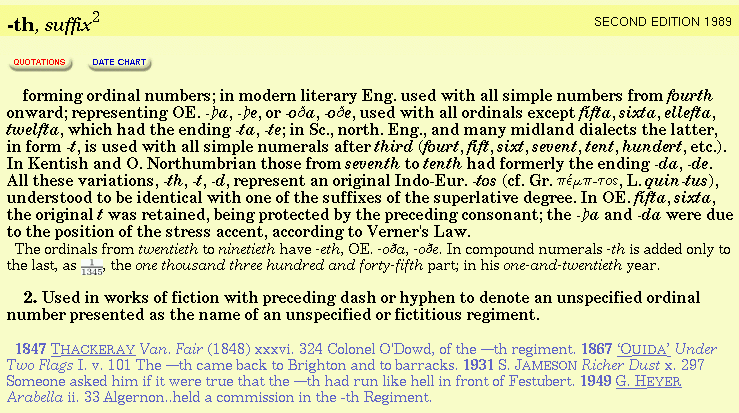
This post has to do with the first post on this blog:
A linguistic study of howmanieth.
So this is a copy of the '-th' suffix form the Internet
Edition of OED Oxford Etymology Dictionary.I am thankful
to Dr.John Smith for the same.This copy has been received
from him though an email conversation.
Please click on the image to maximize so that it can be
read with ease.
Sunday, February 26, 2006
Dombivali Fast & Rang de Basanti
Lot of stuff has been talked about the two.
Both the films-Dombivali Fast & rang de..,you see, seem to be too cognate in their in their content & expression.For a very insightful & sensible article see Saaptaahik SakaL issue of the last week.Ganesh Matkaree makes lot of valid points regarding this.
And very typical critics say that the films are "too cinematic".Or some talk that
either of them is more cinematic whereas the other is not that.Well, opinions vary
for which is what?Let me not enter now in that debate but I will make a point that why do people(actually blockhead critics) think that one is so.
Folks lets make it clear that films need not portray what is desirable or potentially pertinent to take place...films,stories,dramas can also figure out the
extremities that can be reached.And to show extermity doesnt mean that thats it...& thats my stand(my is maker's author's etc)
In Rang de...remember they get a call from a very affluent class based College
Principal who says their act to be a kamzor kadam.What this means is that the Director is well aware of what he is showing but he is trying to figure out the
extremity what they reach.It may seem un-real or for some of you over-cinematic but
we need to take that exteremity to think of the issue more seriously.Well I would say that he has devised extremity to make us feel the issue to its depth of seriuosness which it should attract.
Critics often lead astray [especially those who write in News papers like SakaL(see saptarang 26th feb'06)]without perceiving this extremity as a device but that itself as a target.
May it be Dombivali fast or Rang de.. what one more common feature they share & so far untalked is that both are Meta-films.Well I would say that rang de...is full fledged meta-film.
Meta film:By this vocable I piont out the notion of "above" & not "about"
these films figure out issues from bird's view.The messege is therefore not embeded in the theme but messege is all-pervasive throughout the theme.
Well I stop here & will come up with next Post contd.
Both the films-Dombivali Fast & rang de..,you see, seem to be too cognate in their in their content & expression.For a very insightful & sensible article see Saaptaahik SakaL issue of the last week.Ganesh Matkaree makes lot of valid points regarding this.
And very typical critics say that the films are "too cinematic".Or some talk that
either of them is more cinematic whereas the other is not that.Well, opinions vary
for which is what?Let me not enter now in that debate but I will make a point that why do people(actually blockhead critics) think that one is so.
Folks lets make it clear that films need not portray what is desirable or potentially pertinent to take place...films,stories,dramas can also figure out the
extremities that can be reached.And to show extermity doesnt mean that thats it...& thats my stand(my is maker's author's etc)
In Rang de...remember they get a call from a very affluent class based College
Principal who says their act to be a kamzor kadam.What this means is that the Director is well aware of what he is showing but he is trying to figure out the
extremity what they reach.It may seem un-real or for some of you over-cinematic but
we need to take that exteremity to think of the issue more seriously.Well I would say that he has devised extremity to make us feel the issue to its depth of seriuosness which it should attract.
Critics often lead astray [especially those who write in News papers like SakaL(see saptarang 26th feb'06)]without perceiving this extremity as a device but that itself as a target.
May it be Dombivali fast or Rang de.. what one more common feature they share & so far untalked is that both are Meta-films.Well I would say that rang de...is full fledged meta-film.
Meta film:By this vocable I piont out the notion of "above" & not "about"
these films figure out issues from bird's view.The messege is therefore not embeded in the theme but messege is all-pervasive throughout the theme.
Well I stop here & will come up with next Post contd.
Wednesday, January 18, 2006
Shegaon Kachoree in Aurangabad
This is all for promotion of Shegaon-kachoree:The Divine Delicacy.
Kachoree is simply tasty...neither too spicy nor too hot...
a Saatvik(pure)....satisfying taste....in the history of Chat making.
Each munch of Kachoree a satisfaction par imagination...it will not
simply keep you eating it liberates one from the bandhas of taste & greed
with its ultimate taste....Grab IT.
Shegaon Kachoree was previously sold only at Shegaon.At Shegaon station it is the only attraction for real chat lovers & that was the unique distination to get it.But now it has started its outlet at Aurangabad,Gulmandi.Soon its taste will catch storm in Western Maharashtra.
The Kachoree is served not with Tamrind Chutney but simply fried salted
chillies.Each costs Rs.3.
Don't miss if you happen to visit either of the destinations.
Coming soon to Pune.
Kachoree is simply tasty...neither too spicy nor too hot...
a Saatvik(pure)....satisfying taste....in the history of Chat making.
Each munch of Kachoree a satisfaction par imagination...it will not
simply keep you eating it liberates one from the bandhas of taste & greed
with its ultimate taste....Grab IT.
Shegaon Kachoree was previously sold only at Shegaon.At Shegaon station it is the only attraction for real chat lovers & that was the unique distination to get it.But now it has started its outlet at Aurangabad,Gulmandi.Soon its taste will catch storm in Western Maharashtra.
The Kachoree is served not with Tamrind Chutney but simply fried salted
chillies.Each costs Rs.3.
Don't miss if you happen to visit either of the destinations.
Coming soon to Pune.
Tuesday, January 10, 2006
Those Fergusson Days....
Tonight (9th Jan night) in the HCU library I was reading an Ushas Sukta in
the Rgveda.I remembered those morning classes of F.C in the Sanskrit Dept. where Mrs.Jahnavi Bidnur(Shilpa Mulay) gave us lessons of Rgveda.She used to read out a verse then she used to make us to tell the possible contrual(anvaya)of the verse.Then she used to tell her construal,Roth's,Grassman's & SaayaNaacarya's construal & interpretetion of a verse... that real comprehensive class... we were lucky to have.That winter cold of Fergusson College....Oh..everything seems to have happened just now...these days have passed so fast...like never before.
This time I heard that at Mukta-chhanada katta Atul Kulkarni was
invited & he was to read some his own stuff- some naaTyavaachan of a play written by himself.(I was already told about this by Chinmay Kelkar)But I havent
heard how it went...anyhow its nice to listen that mukta-chhanda katta is doing some sense.
I am translating my 1st post on this blog for a Marathi linguistic
tri-monthly Bhaashaa ani Jeevan.For the same I was re-conforming some references from Rgveda.
I equally miss Lobo sir every now & then.I always felt that instead
of doing B.A Sanskrit(as major) from F.C I should have done B.A Philosophy.
B.A Sanskrit in F.C hardly taught me any Sanskrit (except that what was taught by Mrs.Jahnvi Bidnur)which I'dnt have been able to learn of my own.
Well should I desist to talk anything about the Sanskrit dept.?
Or otherwise it would defame it?& some case would be filed against me.But I dont work in IBM so I wont have to resign !!.......hey just kidding.(this was with ref. to Gaurav Sabnis case.Well a good blogger is pretty aware this case)
I shall come up with a seperate post about Sanskrit & Sanskritists in Pune I met when I was there.Though I am no authority, as a student what I saw,felt I will try to speak out with care.Should I come up with such a post?
Well the comming morning 7:00a.m I have my yoga class to attend.
So that's it.
I miss very much my juniors back in F.C:
Soham,Ameya,Ganesh,Hemant,Neha,Mugdha,Praneeta.
Also my senoirs Sanika(Kelkar),Amruta Chandekar.
the Rgveda.I remembered those morning classes of F.C in the Sanskrit Dept. where Mrs.Jahnavi Bidnur(Shilpa Mulay) gave us lessons of Rgveda.She used to read out a verse then she used to make us to tell the possible contrual(anvaya)of the verse.Then she used to tell her construal,Roth's,Grassman's & SaayaNaacarya's construal & interpretetion of a verse... that real comprehensive class... we were lucky to have.That winter cold of Fergusson College....Oh..everything seems to have happened just now...these days have passed so fast...like never before.
This time I heard that at Mukta-chhanada katta Atul Kulkarni was
invited & he was to read some his own stuff- some naaTyavaachan of a play written by himself.(I was already told about this by Chinmay Kelkar)But I havent
heard how it went...anyhow its nice to listen that mukta-chhanda katta is doing some sense.
I am translating my 1st post on this blog for a Marathi linguistic
tri-monthly Bhaashaa ani Jeevan.For the same I was re-conforming some references from Rgveda.
I equally miss Lobo sir every now & then.I always felt that instead
of doing B.A Sanskrit(as major) from F.C I should have done B.A Philosophy.
B.A Sanskrit in F.C hardly taught me any Sanskrit (except that what was taught by Mrs.Jahnvi Bidnur)which I'dnt have been able to learn of my own.
Well should I desist to talk anything about the Sanskrit dept.?
Or otherwise it would defame it?& some case would be filed against me.But I dont work in IBM so I wont have to resign !!.......hey just kidding.(this was with ref. to Gaurav Sabnis case.Well a good blogger is pretty aware this case)
I shall come up with a seperate post about Sanskrit & Sanskritists in Pune I met when I was there.Though I am no authority, as a student what I saw,felt I will try to speak out with care.Should I come up with such a post?
Well the comming morning 7:00a.m I have my yoga class to attend.
So that's it.
I miss very much my juniors back in F.C:
Soham,Ameya,Ganesh,Hemant,Neha,Mugdha,Praneeta.
Also my senoirs Sanika(Kelkar),Amruta Chandekar.
Sunday, January 08, 2006
Back To HCU
It was 29th of December that I came back to campus of HCU.
However our lectures are to start from 9th January 2006.
So these days I watched two Telugu films:
Ghajini (original Tamil)
Vennela
The former was okay.The latter was just a bakwaas!!
Then on 8th Jan. in HCU campus at DST auditorium I watched Majid-majidi - an Iranian film.
It was a nice film about the fate of a father & his blind son.
Today in the morning there was a film named A night of Prophecy.It depicted the Dalit life in Maharashtra,Telengana;freedom struggle in Nagaland & the plight of Kashmir.With some poems at the score or actually read in the film were conveying enough.The common underlying theme of freedom & struggle was subltly & aesthetically focussed.The film was directed by Kanwar(perhaps Rajesh kanwar).The film has a nice collection of poetic prose pertinently placed throughout.I rememberd Ashish Dixit Of Mumbai when Dadar bridge was shown.I also remembered my Satish mama of Mumbai when sometime back he & I walked through that....well this just personal nostalgia which a critic shuold not intervene while perceiving a film or any aesthetic object....because it mars the reference of the art.However I am not a critic but a normal film goer who goes to film not to enjoy but a feeling of duty(kartavya-buddhi).
Now at 2:30 another film is being screened called Calling bollywood.I am about to go there now.
In today's The Hindu-magazine ( the sunday suppliment) there is some stuff about Sonali Kulkarni.There is a photo of Sonali Kulkarni in which she looks so much like Asin.Hey Ashish(both Dixit & thakare) ( to mention both is so much like Jemima's blog!!)what do you think about her facial resembelence to Asin?
Now here I rush to the other film.ita ito gamyate|
(This is a second post of my blog.The first one purely technical paper of mine)
However our lectures are to start from 9th January 2006.
So these days I watched two Telugu films:
Ghajini (original Tamil)
Vennela
The former was okay.The latter was just a bakwaas!!
Then on 8th Jan. in HCU campus at DST auditorium I watched Majid-majidi - an Iranian film.
It was a nice film about the fate of a father & his blind son.
Today in the morning there was a film named A night of Prophecy.It depicted the Dalit life in Maharashtra,Telengana;freedom struggle in Nagaland & the plight of Kashmir.With some poems at the score or actually read in the film were conveying enough.The common underlying theme of freedom & struggle was subltly & aesthetically focussed.The film was directed by Kanwar(perhaps Rajesh kanwar).The film has a nice collection of poetic prose pertinently placed throughout.I rememberd Ashish Dixit Of Mumbai when Dadar bridge was shown.I also remembered my Satish mama of Mumbai when sometime back he & I walked through that....well this just personal nostalgia which a critic shuold not intervene while perceiving a film or any aesthetic object....because it mars the reference of the art.However I am not a critic but a normal film goer who goes to film not to enjoy but a feeling of duty(kartavya-buddhi).
Now at 2:30 another film is being screened called Calling bollywood.I am about to go there now.
In today's The Hindu-magazine ( the sunday suppliment) there is some stuff about Sonali Kulkarni.There is a photo of Sonali Kulkarni in which she looks so much like Asin.Hey Ashish(both Dixit & thakare) ( to mention both is so much like Jemima's blog!!)what do you think about her facial resembelence to Asin?
Now here I rush to the other film.ita ito gamyate|
(This is a second post of my blog.The first one purely technical paper of mine)
Sunday, December 25, 2005
A linguistic study of howmanieth
A Linguistic Study of howmanieth
Chinmay Dharurkar
Though many Indian languages have a separate vocable for the interrogative ordinal pronoun, as kitva in Marathi many of the world languages don’t. Hindi, English, Arabic etc. can be a list of such languages that lack the lexeme. As does Marathi, so do: Gujarati (keTlAmo), Kannada (), Telugu (), Persian (), German (), etc. have the exact equivalent.
In Sanskrit katama is believed to be the exact equivalent for it. However that is a misunderstanding (especially of the Indian Sanskritists) and not katama, but katitha is the exact equivalent for it. To prove this is one of the aims of this paper.
Many Lexicographers coin howmanieht/howmaiest (Monier-Williams, 2003/1899:246) as equivalents of katitha. So do Sanskrit-Hindi lexicographers kitnava (Suryakant, 1981) as a Hindi equivalent of katitha. This paper also aims to see if the English suffix –th (of fourth, fifth etc.) is cognate to Sanskrit suffix –thuk (as called by Panini) i.e –th of caturtha, sHasHTha, katitha & katipayatha.
Let’s see how katitha, and not katama, is appropriate to mean ‘which in the order or series’ (howmanieht hereafter) i.e ordinal interrogative sense. Probing a little will explicate the things. It was always katitha in Sanskrit that meant howmanieth whereas katama always meant which one in the many scattered things. We are going to see how this is evinced by the Sanskrit literature throughout. But let’s have a look at the Paninian sutras pertaining katama and katitha.
Panini proposes Datamac suffix being there in katama in the sUtra:
1. a) vaa bahunaam jaati-pariprashne Datamac (5.3.93)
The preceding sutra is:
b) kim-yat-tador-nirdharaNe dvayorekasya Datamac (5.3.92)
According to 1a) pari-prashna i.e interrogation is possible only in the case of kim. The two yat, tat not being interrogative pariprashna simply cannot be there in their case. JaatigrahaNa is possible. Vaa reveals the option of the forms viz. yakaH, sakaH. This sutra generates katama, yatama and tatama. The same jaatigrahaNa or pariprashna when in case of two Datarac applies and katara, yatara and tatara these praatipadakas are formed.
2) sHaT-kati-katipaya-caturaam thuk (5.2.91)
Tasya pUraNe DaT (5.2.28) this sutra proposes the ordinal suffix DaT and the following sutras describe the options, augments that happen for the suffix DaT. So is –thuk an agama (augment) for the suffix DaT, which is naked in sHasHTha, katitha, katipayatha, caturtha. The other agamas like maDAgama, tamaDAgama etc. other agamas are also seen in the forms prathama, navama, saptama along with sHasHTitama, saptatitama etc.
It is noteworthy that –tama in katama is not tamaDAgama of ordinality suffix DaT but of Datamac. The two Datamac and DaT’s tamaDAgama are different suffixes that get attached to different roots. This clarifies that katama doesn’t at all mean howmanieth but katitha alone means howmanieth. Katama simply means who or which one of many. In other words there in no sense of ordinality in katama as there is no ordinal suffix in it. So it can mean only which i.e. of jaatipariprshna. On the other hand katitha unambiguously means howmanieth. To put it in other words katama pervades a larger domain of meaning katitha however denotes a particular domain of meaning within the larger domain of katitha. It means that all the answers of the enquiry of katitha will be answers of katama but not the vice-versa. For instance ‘which boy’ may have answers like ‘tall boy’ or ‘first boy’. Both the responses will do. But ‘howmanieth boy’ cannot have ‘tall boy’ as its valid answer. Only some ordinal has to be the answer. In katama or ‘which’ not only pariprashna but also jaati is incorporated. (jaatyaa kriyayaa guNena sanjnyayaa vaa samudaayaadekadeshasya pruthak-karaNam nirdhaaraNa iti kaashikaa under 5.3.92). It is difficult to carry out this nirdhaanraNa using the ordinal suffix, as for the nirdhaaraNa of the scattered things, using katama is more appropriate, as any order is absent in the scattered things. We may insist upon putting ordinality under the head of guNa but that guNa won’t the fundamental, embodied quality of the substantive. It will have to depend upon the order that is pre-determined by the cardinal numbers, which is formally realized in ordinal numbers. In other words it will be an adjective of Identity or upalakSHaNa that is imposed upon on it in relation to the facts external or extrinsic to it.
It is intriguing that though ordinals are cognized by the human mind as adjectives their interrogation is carried out in a different way by using a separate ordinal interrogative pronoun viz. katitha, kitvaa, ennova, eShTaneya etc. (at least in case of the languages that have one of this kind). Perhaps, in the course of human evolution invention of numbers being quite a latest event it might have been contrived by some of the languages to have separate interrogative pronouns for the distinct domains of the enquiry of adjectives and ordinals. So I not only argue that which has a larger domain and howmanieth a specific, but also: number itself being an abstraction it simply cannot be an intrinsic quality of substantive, that denotation will always be relative. For example when we say ‘a fat boy’ fatness can be believed to be residing in the boy in the form of some extra layer of accumulated fats causing obesity, so is not the case in ‘fifth boy’. It is not the fifth-ness that resides in the boy but it is the boy who occupies the position marked with the cardinal number five. This is sense of occupation or filling up may be intended in Paninian term puuraNa.
The above discussion is about how katama-katitha are different from each other.
For the sake of curious readers following are the related Panini sutras:
1. tasya puuraNe DaT (5.2.48)
2. naantaadasankhyaadermaT (5.2.49)
3. *thaT ca chandasi (5.2.50)
4. sHaT-kati-katipaya-caturaam thuk (5.2.51)
5. *dvestiiyaH (5.2.53)
6. *treH samprasaaraNam ca (5.2.54)
7. *vinshatyaadibhistamaDanyatarasyaam (5.2.56)
8. *nityam shataadi-maasaardha-maasa-sanvtsaraat ca (5.2.57)
9. *sHasHTyaadeshcaasankhyaadehe (5.2.58)
(The asterisked sutras are mentioned in the later part of the paper or mere related. So far those have not been discussed.)
We discussed the semantic distinction between katama-katitha using Panini-sutras. But the occurrences from the Sanskrit literature do also support the facts that we discussed. Having found out the occurrences and the meaning of katama-katitha in Sanskrit literature from Deccan College Scriptorium of The Sanskrit Dictionary Project it was found that the two lexemes were never inter-mingled and have been in the language independently.
Katama-katitha occurrences, the text and translation:
Katama:
1. Rgveda 1.35.7
Vi suparNo antrixaaNyakhyad-gabhiirvepaa asuraH sunithaH |
Kvedaaniim suuryaH kashciketa katamaam dyaam rashmirasya tataana ||
[Construal: asuraH gabhiiravepaaH suniithaH suparNaH antarixaaNi vykhyat, idaaniim kva katamaam dyaam asya rashmiH aatataana kaH ciketa?]
Meaning: That which possesses pranas, that who has minute, intense or recondite vibrations, the one provides object in the best way, the one has good leaves/ rays – that Suurya , where is he? Who knows to which directions are his rays spread?
2. Rgveda 2.24.1
kasya nUnam katamasyaamrutaanaam manaamahe chaaru devasya naama|
Ko no mahyaa aditaye punardaatpitaram ca drsheyam maataram ca||
Meaning: Which god shall we believe to be indicative of amruta (nectar)?
The one who gives the nourishing earth and also the parents: father and mother.
3. ChaandogyopaniShat 1.1.4
katamaa katamark-katamat-katamatsaama katamaH |
katama udgiitha iti vimruShaTam bhavati ||
Meaning: Which is the Rk? Which is the saama? Which is the udgiitha? This is being thought.
(Total occurrences of katama in Upanishad (10) literature: 14)
4. Mahabharata
Total occurrences: 14
1) 1.88.9c vidyaat alakshmiiH katamam janaanaam
2) 1.224.22a jyeshThaH sutaste katamaH
3) 1.224.22c madhyamaH katamaH putraH
4) 3.123.12a tatastsyaavayoschaiva
5) 4.40.1c katamam yaasyeniikam
6) 4.45.9a katamad dvairatham yuddham
7) 4.45.11a tathaiva katamam yuddham
8) 4.50.3c katamam yaasyeniikam
9) 5.36.8c vidyaat alakshmiH katamam janaanaam
10) 5.43.24c tesHaam tu katamaH sa syaad
11) 5.101.20a kaH pitaa jananii chaasya
12) 12.262.32a etsHaam pretyabhaave tu katamaH
13) 12.263.5a tatashcintaam punaH praptaH katamad
14) 12.319.19a daivatam ktamam hyetad
Each and every occurrence of katama over here means which and nowhere howmanieth. For example we will discuss 2, 3.
2) 1.224.22a jyeshThaH sutaste katamaH katamatadanantaraH |
madhyamaH katamaH putraH kanishThaH katamascha te ||
Meaning: Which is your eldest son? Which is the one next to him?
Which is the middle one and which is the youngest one?
Also of 4) 3.123.12a tatastsyaavayoschaiva is remarkable as there is no katama in it but ekatama. This verse form Aranya parvan of Mahabharata is uttered by Ashwinas wherein the wife of Chyanvan Rshi is addressed whom they happen to see in the forest.
The complete shloka follows:
tatastsyaavayoschaiva patimekatamam vrNu |
etana samayenainamantraya varaananane ||
aavayoschaiva patimekatamam vrNu : Choose one of us as your husband.
Here ekatamam has alternative reading as ekataram or anyatamam. This is noteworthy. More discussion on this: at the end of the paper.
5.Vikramorvashiiyam –
api jnaayate katamena digbhaagena gataH sa jaalmaH
(act 1, the king addressing to Menaka)
Menaka informs Raja that a daanava kidnapped Urvashi. In response to this the king asks her the quoted question : “To which direction did the abject go?”
6. Abhijnaanshaakuntalam –
(1) atha katamam rtum adhikrtya gaasyaami
(Act 1, says NaTi to the sUtradhaara , before the shloka 3 of the act)
“Now pertaining to which season should I sing the song?”
(2) tadidaaniim katamatprakaraNamaashrityainamaaraadhayaamaH ||
(Act 1,sUtrasdhaara, before shloka 4 of the act)
“then with which prakaraNa (drama,play) are we going to entertain them (the audience)
Apart form these occurrences katama is found in the medieval Sanskrit in plenty of instances. These would suffice here. For other shades of meaning of katama curious readers may look into the Monier-Williams and the Apte V.S dictionaries.
Katitha:
1.Rgveda 10.61.18
tadbandhuÏ sÂrir divi te dhiyaÎdhÀ nÀbhÀnediÍÊho rapati pra venan
sÀ no nÀbhiÏ paramÀsya vÀ ghÀhaÎ tat paÌcÀ katithaÌ cid Àsa
Translation: Their kin, the Prince in heaven, thy nearest kinsman, turning his thought to thee thus speaks in kindness : This is our highest bond: I am his offspring. How many others came ere I succeeded?
2.Mahapurana 1.1.75 (Bhagvad-Jinasenacarya’s Sanskrit Mahapurana)
Yugasya katithe bhaage manavo manvate ca kim|
Kin vaa manvantaram deva tattvam me brUhi tattvataH||
In howmanieth part of the age what did the men believe?
Or in principle what other opinion was held by a group, O lord!
tell me that.( The present shloka is amongst the one of the shlokas wherein the
disciple is interrogating the Guru with excessive question.
3.Samaraaditysankshepa 5.840a (Jaina Champu 1268 A.D)
Kaalena katithena api pitroho panchatvam iyuShoHo|
Shrikaant-nilayaa-bhikhyam raajye nyastham nijaanujam||
After passing away of father he set his own younger brother named Shrikantanilaya on the throne in some-manieth year.
4.Dvyashrayamahakavya 18.53,54 (1100-1173 A.D)
gaNatithairiha sanghtithaa bhaTairamarapUgatithatvam ayurhataaH |
virahiteyatithaiH katithaischamUriti kinchidabudhyata tatra tu||
( The idea in the first line is that the soldiers of a side killed a number of soldiers of the opposite side, and the same is expressed in: gaNatithairiha sanghtithaaH hataaH. In the second line the question being raised is that “howmanieth soldiers of an army did kill the groups of the soldiers of the opposite?” It is answered as that was not known. The bravery of the soldiers of the army is revealed in this way.
The number of soldiers – belonging to one side, that form a gaNa killed the number of soldiers that form a sangh. So-manieth or howmanieth soldiers did kill them – this however was not known.
balkatipayathaH kopi dordvitiiyastUNastrtiiyaH saddhanushcaturthaH |
shaSHTham turyam vidvisHam nrpasy ghnanshchakre bhartraatmanasturiiyaH ||
( The verse tells that the king promoted one of the soldiers to fourth place from him. How that soldier was brave is evident from rest of the adjectives of the soldier in the verse. The use of katipayatha in the verse is remarkable.)
The one in whom the force of the many is occupied (i.e. the one who is puuraNa of the many in terms of might or force), the one whom arms are dvitiiyas, the one whom bow is trtiiya and the one who has subdued the fourth and the sixth (soldiers) – to such soldier of his own army the king promoted to the fourth position (in order to felicitate the gallantry exhibited by the soldier)
5. Shishupalvadha – 15.42c
Vihitaagaso muhuralnghyanijavacnadaamasanyataH |
Tasya katitha iti tat-prathamam manasaa samaakhyadaparaadhamacyutaH ||
Because of the promise Krishna (that he had agreed to keep to Shatvati who was his paternal aunt and Shishupala’s mother) was bound, he counted in his mind as “howmaieth sin is this one” the sins of Shishupala from one, though he had already committed many before.
From these occurrences of katama-katitha the following facts are clear:
1) katama throughout Sanskrit language (i.e. in all periods: Vedic, Classical and modern) meant which and not howmanieth.
2) Katitha is available even in post-vedic Sanskrit. This is clear from its occurrences in Shishupalvadha etc.
3) So is the difference between katama-katitha is made clear in meaning and function. So the occurrences are evinced.
DaT is originally an ordinal suffix. The rest are its agamas.( But tiiya in 5.2.54, 55 is an exception of DaT. The agamas are maDaagama ( found in saptama, navama etc.), thugaagama (found in caturtha, shaShTh, katitha and katipayatha) and tamaDaagama ( found optionally in the cardinals after 20 so we get the forms like vinsha or vinshatitama until 60. Sixty onwards there is no option for tamaDaagama.)
Now when this large is the paradigm of the tamaDaagama i.e from 20 to 60 optionally and without option there onwards, there should have been tama in the interrogative suffix of the ordinals. On the contrary when thuk has such a small paradigm of just four occurrences out of which just two are in the ordinals why then it enjoys the position in the interrogation of the ordinals?
Though not much, a satisfactory explanation of this can be that in the preceding of sutra 5.2.51 which reveals thugaagma i.e 5.2.50 : thaT ca chandasi it is informed that in Vedas the nanta cardinals get the ordinal suffix thaT . So do occur the forms like pancatha, sapthatha. By this sutra, though not much the paradigm of –tha has been increased. We cannot deny the possibility of –tha being more productive in the pre-vedic variety of Sanskrit, as the –th is productive in most of the ordinals in English form 4 onwards.
Now we may turn to the second point of the paper to see if the –th in English and the -th in thugaagama in Sanskrit are cognate?
Before turning to this question we will note an observation. In Sanskrit –tama occurs in three cases with the three different functions.:
1. tamaDaagama: aagama of the ordinal suffix –DaT
2. tamavAcaka: the superlative degree suffix as told in the sutra aatishaayane tamabiShThanau (5.3.55) found in sundartama (the most beautiful), uttama (the best) etc.
3. Datamac in va bahUnaam jaatipariprashaneDatamac (5.3.92)
-tama suffixes are going to be discussed later in detail. Here those have been just listed.
OED (Oxford Etymology Dictionary) entry for –th suffix in English follows:
“ The suffix –th in English had variations –th, -t, -d that represent an original IE
–tos (cf. Latin –quintus), understood to be identical with the superlative degree.”
The last part of the entry is intriguing directing us to think in the direction of identicality of the ordinal and the superlative suffix. And so have we already listed the tamavaacaka and the tamaDaagama above, to be considered later. Though it is not mandatory to mean the same when something sounds identical as here the ordinal suffix and the superlative suffix we are incited and encouraged to think over the similarities and differences between the ordinal suffix and the superlative suffix and the also the concept of ordinality the nature of the superlative degree. According to the above quoted OED entry IE suffix –tos is the one that is represented by the therein mentioned variations of the English suffix and it is believed to be identical with the superlative suffix. One may formulate the suffix in the PIE and then we would be able to make some definite statements about the English ¬–th and the Sanskrit –th are cognate or not.
Here we are not concerned with the –th in the English and the Sanskrit suffix but with the function it carries out while describing superlativity or tamabhaava and ordinality. We mentioned the superlative and the ordinal suffix -tama above. Let’s now discuss in detail. The similarities and the differences, between the roots, to which the -tama (both the superlative and the ordinal) gets attached and the words thus generated, are:
1. Phonetic Similarity: -tama suffix is similar in pronunciation
2. Adjectives as roots: -tama gets attached to the roots that are adjectives. (Needless to say that numbers are adjectives!)
3. Specificity : Both the words generated by the suffixation are of a peculiar kind of adjectives that determine or express the specificity of the substantive. The usual function of adjectives is isolation (vyaaavartakam visheShaNam). But the superlatives and the ordinals specify among the ones already isolated by adjectives. It is for this reason the use of article “the” is seen. ( However in “He stood first in class” here “first” is not adjective but adverb of position. Also in usage like “a fastest” a stands for the sense of “one of the fastest”.)
Now let’s see the differences:
1. The ordinal –tama denotes only the position that is occupied by some noun (it tells only the cardinal number which is occupied by something, for this occupying PaNini is saying puuraNa ). It tells only the number in the order not the embodied quality of the substantive. Whereas the superlative –tama tells the excessive presence of the quality. This means that the ordinals behave like demonstrative pronouns or articles that again behave like adjectives. ( As the tad pronoun in Sanskrit inflects differently in three genders and the articles in French, German etc. agree to the noun in person, number and gender.
2. Putting the same thing in different words: When we use ordinals there is expectancy or akaankShaa of other counting numbers or fractions and one of these is denoted in the ordinals. Whereas in the superlatives there is expectancy of the minimum three substantives that have the same qualifying adjective, and in one those the excess of the quality is expressed by the superlative. So even though the specificity is there in both the cases, the one in the superlatives is the specificity with respect to the excess of the quality and in the ordinals the specificity of the position in the order. The first specificity of quality resides in the substantive whereas the specificity of order doesn’t reside in the substantive but a mere understanding due to the cognitive consensus of believing in order which is outside or extrinsic to the substantive.
Panini names the superlative suffix tamap and the ordinal suffix –DaT , and one of the agamas of –DaT is named tamaT. The different names are for the different functions they perform.
Let’s discuss a bit about the superlative forms and the comparative forms. Actually there is no difference between the superlatives and the comparatives except for the number of the substantives under comparison. Because both the forms show the excess of quality amongst the many (i.e. two or many). To verify this we will have to search such a language that has no difference between the two forms: the superlative and the comparative.
One thing is sure that the notion of the superlative and the comparative, as a notion will be found in all of the languages, but we are interested if, unlike Sanskrit, no different marking takes place for the superlative and the comparative forms. Arabic is one such language. For instance, “Ashok akbaru min-Nishikaant” here akbaru is a derivative of the root kabura meaning to be great, old, big. First in the sense of old the form akbar is derived and to compare with someone the akbaru min such construction is done. To say the same in the superlative sense it would be said as Ashok al-akbara (Ashok is the eldest). Here ru becoming ra has no connection with the superlative form. It is due to the article Al. Most of the modern Indian languages don’t have the comparative and superlative distinct forms. In Marathi, Hinidi, Gujarati and many others the Comparative- Superlative distinction is analytical unlike Sanskrit which is morphological.
Actually, even in two an-ekatva (the notion of not-one) is there. Then why such special treatment or arrangement for two in Sanskrit, German, Persian etc by morphologically distinct superlative and comparative forms?
This might support the Rajwade’s [ Shah (edt.) 1995:40] opinion about the invention of two. Rajwade argues that man invented two far before he conceived numbers more than two. The existence of comparative forms may be hinting this posteriority of dual forms (-that may be remains of the far-before invented two as Rajwade argues).
Just related to this a note on katama and katara in Mahabhashya is significant, which will help us reconcile the occurrences and readings in Mahabharata of ekatara and ekatama. In the Bhashya and in the commentaries Pradiipa and Udyaota to Sutra vaa bahunaam jaati-pariprashne Datamac (5.3.93) there is an occurrence of katara in the sense of “which one of many” i.e. katara has occurred instead of katama. It is clear that this is non-Paninian usage. The commentary gives the usage : bahuShu aasiineShu kashcit kanchit prcchhati kataro devadatta iti. Here katara has occurred instead of katama. One explanation that can be given of this usage is that, in the mind of the one who is asking, are two sets. One set of all such individuals that are not Devadatta and the other containing single member – Devadatta. Now, within these two the enquiry takes place so, kataro devadattaH works alright. Another explanation can be that in the mid of the one who is asking are un-ordered pairs of individuals, one of which is Devadatta and the other is not. Within these two the enquiry takes place this one or this one?
Also, where Datarac should have been there, Datamac was found in the verse of Mahabharata viz. aavayoH ekatamam, which we have seen. Rajwade’s opinion can be thought over here as, once duality(dvitva) gets merged into plurality(anekatva) merging of the respective forms is natural.
References:
(A) Dictionaries-
1. Apte, V.S [1890 (1965)] The Practical Sasnkrit-English Dictionary. Motilal Banarasidas, New Delhi.
2. Deccan College Scriptorium, Sanskrit Dictionary Project, Deccan College, Pune.
3. Monier-Williams [1899(2002)] A Sasnkrit English Dictionary, Motilal Banarasidas, New Delhi.
4. Suryakanta (1981) A Practical Vedic Dictionary. OUP, New Delhi.
(B) Other-
1. Joshi, B.B (Edt.) (1992) VyaakaraNa-mhaabhaashya(kaiyyaTpradipiikaa va naageshbhaTT-krta pradiipodyat Tiikaa-sahita 6 volumes) Vajrajiivan Praachyabharati Granthmala- 23, Chaukhamba, Delhi.
2. Mishra, Narayan (edt.) (2001) Vaamanajayaaditya-krta Kashikaa. Kashi Sanskrit Granthmala- 37, Chaukhamba, Delhi.
3. Shah, M.B (edt.) (1991) Itihaasaacarya Vi. Ka. Rajwaade samagra saahitya, Vol 3, Sasnkrt-bhaaShaa va BhaaShaashaastriiya lekh (in Marathi), Rajwade Sanshodhan Mandal, Dhule.
(C) References for katama-katitha:
1. Kale, M.R (edt.) (1961) Abhijnaanshakuntal. Motilal Banarasidas, New Delhi.
2. Jain, Pannalal (edt.) (1944) Mahapurana khanD -1 Adipuarana Bhagvajjinsenaacryakrta.
3. Velankar, H.D (edt.) (1961) vikramorvashiiya. Sahitya Akademi, New Delhi.
4. Shastri, Harigovind (edt.) (1961) Shishupalvadha. Vidya Bhavan Sanskrit Granthmala – 8, Chaukhamba, New Delhi.
5. Sadhle G.S (edt.) (1987) UpaniShat-mahaavaakyakosha. Shri Sadguru Publications, New Delhi.
6. Sukhthankar, V.S, Belvalkar, S.K (edt) (1954) The Mahabharata. Critical Edition. BORI, Pune.
7. Sontakke, N.S, Kashikar, C.G. (1983) Rgvedasanhitaa. Vaidika Sanshodhan Mandal, Pune.
8. Swami Dayanand Saraswati, (1973) Rgveda. Dayanand Sansthan, New Delhi.
Note: The exact references for SamardityasankShepa and Dvyaashrayamahaakaavya not available as the title page was missing at the source i.e. Sanskrit Dictionary Project Library, Deccan College, Pune. However the books/pothis may be accessible through the title catalogue of the Sanskrit Dictionary Project Library.
Chinmay Dharurkar
Though many Indian languages have a separate vocable for the interrogative ordinal pronoun, as kitva in Marathi many of the world languages don’t. Hindi, English, Arabic etc. can be a list of such languages that lack the lexeme. As does Marathi, so do: Gujarati (keTlAmo), Kannada (), Telugu (), Persian (), German (), etc. have the exact equivalent.
In Sanskrit katama is believed to be the exact equivalent for it. However that is a misunderstanding (especially of the Indian Sanskritists) and not katama, but katitha is the exact equivalent for it. To prove this is one of the aims of this paper.
Many Lexicographers coin howmanieht/howmaiest (Monier-Williams, 2003/1899:246) as equivalents of katitha. So do Sanskrit-Hindi lexicographers kitnava (Suryakant, 1981) as a Hindi equivalent of katitha. This paper also aims to see if the English suffix –th (of fourth, fifth etc.) is cognate to Sanskrit suffix –thuk (as called by Panini) i.e –th of caturtha, sHasHTha, katitha & katipayatha.
Let’s see how katitha, and not katama, is appropriate to mean ‘which in the order or series’ (howmanieht hereafter) i.e ordinal interrogative sense. Probing a little will explicate the things. It was always katitha in Sanskrit that meant howmanieth whereas katama always meant which one in the many scattered things. We are going to see how this is evinced by the Sanskrit literature throughout. But let’s have a look at the Paninian sutras pertaining katama and katitha.
Panini proposes Datamac suffix being there in katama in the sUtra:
1. a) vaa bahunaam jaati-pariprashne Datamac (5.3.93)
The preceding sutra is:
b) kim-yat-tador-nirdharaNe dvayorekasya Datamac (5.3.92)
According to 1a) pari-prashna i.e interrogation is possible only in the case of kim. The two yat, tat not being interrogative pariprashna simply cannot be there in their case. JaatigrahaNa is possible. Vaa reveals the option of the forms viz. yakaH, sakaH. This sutra generates katama, yatama and tatama. The same jaatigrahaNa or pariprashna when in case of two Datarac applies and katara, yatara and tatara these praatipadakas are formed.
2) sHaT-kati-katipaya-caturaam thuk (5.2.91)
Tasya pUraNe DaT (5.2.28) this sutra proposes the ordinal suffix DaT and the following sutras describe the options, augments that happen for the suffix DaT. So is –thuk an agama (augment) for the suffix DaT, which is naked in sHasHTha, katitha, katipayatha, caturtha. The other agamas like maDAgama, tamaDAgama etc. other agamas are also seen in the forms prathama, navama, saptama along with sHasHTitama, saptatitama etc.
It is noteworthy that –tama in katama is not tamaDAgama of ordinality suffix DaT but of Datamac. The two Datamac and DaT’s tamaDAgama are different suffixes that get attached to different roots. This clarifies that katama doesn’t at all mean howmanieth but katitha alone means howmanieth. Katama simply means who or which one of many. In other words there in no sense of ordinality in katama as there is no ordinal suffix in it. So it can mean only which i.e. of jaatipariprshna. On the other hand katitha unambiguously means howmanieth. To put it in other words katama pervades a larger domain of meaning katitha however denotes a particular domain of meaning within the larger domain of katitha. It means that all the answers of the enquiry of katitha will be answers of katama but not the vice-versa. For instance ‘which boy’ may have answers like ‘tall boy’ or ‘first boy’. Both the responses will do. But ‘howmanieth boy’ cannot have ‘tall boy’ as its valid answer. Only some ordinal has to be the answer. In katama or ‘which’ not only pariprashna but also jaati is incorporated. (jaatyaa kriyayaa guNena sanjnyayaa vaa samudaayaadekadeshasya pruthak-karaNam nirdhaaraNa iti kaashikaa under 5.3.92). It is difficult to carry out this nirdhaanraNa using the ordinal suffix, as for the nirdhaaraNa of the scattered things, using katama is more appropriate, as any order is absent in the scattered things. We may insist upon putting ordinality under the head of guNa but that guNa won’t the fundamental, embodied quality of the substantive. It will have to depend upon the order that is pre-determined by the cardinal numbers, which is formally realized in ordinal numbers. In other words it will be an adjective of Identity or upalakSHaNa that is imposed upon on it in relation to the facts external or extrinsic to it.
It is intriguing that though ordinals are cognized by the human mind as adjectives their interrogation is carried out in a different way by using a separate ordinal interrogative pronoun viz. katitha, kitvaa, ennova, eShTaneya etc. (at least in case of the languages that have one of this kind). Perhaps, in the course of human evolution invention of numbers being quite a latest event it might have been contrived by some of the languages to have separate interrogative pronouns for the distinct domains of the enquiry of adjectives and ordinals. So I not only argue that which has a larger domain and howmanieth a specific, but also: number itself being an abstraction it simply cannot be an intrinsic quality of substantive, that denotation will always be relative. For example when we say ‘a fat boy’ fatness can be believed to be residing in the boy in the form of some extra layer of accumulated fats causing obesity, so is not the case in ‘fifth boy’. It is not the fifth-ness that resides in the boy but it is the boy who occupies the position marked with the cardinal number five. This is sense of occupation or filling up may be intended in Paninian term puuraNa.
The above discussion is about how katama-katitha are different from each other.
For the sake of curious readers following are the related Panini sutras:
1. tasya puuraNe DaT (5.2.48)
2. naantaadasankhyaadermaT (5.2.49)
3. *thaT ca chandasi (5.2.50)
4. sHaT-kati-katipaya-caturaam thuk (5.2.51)
5. *dvestiiyaH (5.2.53)
6. *treH samprasaaraNam ca (5.2.54)
7. *vinshatyaadibhistamaDanyatarasyaam (5.2.56)
8. *nityam shataadi-maasaardha-maasa-sanvtsaraat ca (5.2.57)
9. *sHasHTyaadeshcaasankhyaadehe (5.2.58)
(The asterisked sutras are mentioned in the later part of the paper or mere related. So far those have not been discussed.)
We discussed the semantic distinction between katama-katitha using Panini-sutras. But the occurrences from the Sanskrit literature do also support the facts that we discussed. Having found out the occurrences and the meaning of katama-katitha in Sanskrit literature from Deccan College Scriptorium of The Sanskrit Dictionary Project it was found that the two lexemes were never inter-mingled and have been in the language independently.
Katama-katitha occurrences, the text and translation:
Katama:
1. Rgveda 1.35.7
Vi suparNo antrixaaNyakhyad-gabhiirvepaa asuraH sunithaH |
Kvedaaniim suuryaH kashciketa katamaam dyaam rashmirasya tataana ||
[Construal: asuraH gabhiiravepaaH suniithaH suparNaH antarixaaNi vykhyat, idaaniim kva katamaam dyaam asya rashmiH aatataana kaH ciketa?]
Meaning: That which possesses pranas, that who has minute, intense or recondite vibrations, the one provides object in the best way, the one has good leaves/ rays – that Suurya , where is he? Who knows to which directions are his rays spread?
2. Rgveda 2.24.1
kasya nUnam katamasyaamrutaanaam manaamahe chaaru devasya naama|
Ko no mahyaa aditaye punardaatpitaram ca drsheyam maataram ca||
Meaning: Which god shall we believe to be indicative of amruta (nectar)?
The one who gives the nourishing earth and also the parents: father and mother.
3. ChaandogyopaniShat 1.1.4
katamaa katamark-katamat-katamatsaama katamaH |
katama udgiitha iti vimruShaTam bhavati ||
Meaning: Which is the Rk? Which is the saama? Which is the udgiitha? This is being thought.
(Total occurrences of katama in Upanishad (10) literature: 14)
4. Mahabharata
Total occurrences: 14
1) 1.88.9c vidyaat alakshmiiH katamam janaanaam
2) 1.224.22a jyeshThaH sutaste katamaH
3) 1.224.22c madhyamaH katamaH putraH
4) 3.123.12a tatastsyaavayoschaiva
5) 4.40.1c katamam yaasyeniikam
6) 4.45.9a katamad dvairatham yuddham
7) 4.45.11a tathaiva katamam yuddham
8) 4.50.3c katamam yaasyeniikam
9) 5.36.8c vidyaat alakshmiH katamam janaanaam
10) 5.43.24c tesHaam tu katamaH sa syaad
11) 5.101.20a kaH pitaa jananii chaasya
12) 12.262.32a etsHaam pretyabhaave tu katamaH
13) 12.263.5a tatashcintaam punaH praptaH katamad
14) 12.319.19a daivatam ktamam hyetad
Each and every occurrence of katama over here means which and nowhere howmanieth. For example we will discuss 2, 3.
2) 1.224.22a jyeshThaH sutaste katamaH katamatadanantaraH |
madhyamaH katamaH putraH kanishThaH katamascha te ||
Meaning: Which is your eldest son? Which is the one next to him?
Which is the middle one and which is the youngest one?
Also of 4) 3.123.12a tatastsyaavayoschaiva is remarkable as there is no katama in it but ekatama. This verse form Aranya parvan of Mahabharata is uttered by Ashwinas wherein the wife of Chyanvan Rshi is addressed whom they happen to see in the forest.
The complete shloka follows:
tatastsyaavayoschaiva patimekatamam vrNu |
etana samayenainamantraya varaananane ||
aavayoschaiva patimekatamam vrNu : Choose one of us as your husband.
Here ekatamam has alternative reading as ekataram or anyatamam. This is noteworthy. More discussion on this: at the end of the paper.
5.Vikramorvashiiyam –
api jnaayate katamena digbhaagena gataH sa jaalmaH
(act 1, the king addressing to Menaka)
Menaka informs Raja that a daanava kidnapped Urvashi. In response to this the king asks her the quoted question : “To which direction did the abject go?”
6. Abhijnaanshaakuntalam –
(1) atha katamam rtum adhikrtya gaasyaami
(Act 1, says NaTi to the sUtradhaara , before the shloka 3 of the act)
“Now pertaining to which season should I sing the song?”
(2) tadidaaniim katamatprakaraNamaashrityainamaaraadhayaamaH ||
(Act 1,sUtrasdhaara, before shloka 4 of the act)
“then with which prakaraNa (drama,play) are we going to entertain them (the audience)
Apart form these occurrences katama is found in the medieval Sanskrit in plenty of instances. These would suffice here. For other shades of meaning of katama curious readers may look into the Monier-Williams and the Apte V.S dictionaries.
Katitha:
1.Rgveda 10.61.18
tadbandhuÏ sÂrir divi te dhiyaÎdhÀ nÀbhÀnediÍÊho rapati pra venan
sÀ no nÀbhiÏ paramÀsya vÀ ghÀhaÎ tat paÌcÀ katithaÌ cid Àsa
Translation: Their kin, the Prince in heaven, thy nearest kinsman, turning his thought to thee thus speaks in kindness : This is our highest bond: I am his offspring. How many others came ere I succeeded?
2.Mahapurana 1.1.75 (Bhagvad-Jinasenacarya’s Sanskrit Mahapurana)
Yugasya katithe bhaage manavo manvate ca kim|
Kin vaa manvantaram deva tattvam me brUhi tattvataH||
In howmanieth part of the age what did the men believe?
Or in principle what other opinion was held by a group, O lord!
tell me that.( The present shloka is amongst the one of the shlokas wherein the
disciple is interrogating the Guru with excessive question.
3.Samaraaditysankshepa 5.840a (Jaina Champu 1268 A.D)
Kaalena katithena api pitroho panchatvam iyuShoHo|
Shrikaant-nilayaa-bhikhyam raajye nyastham nijaanujam||
After passing away of father he set his own younger brother named Shrikantanilaya on the throne in some-manieth year.
4.Dvyashrayamahakavya 18.53,54 (1100-1173 A.D)
gaNatithairiha sanghtithaa bhaTairamarapUgatithatvam ayurhataaH |
virahiteyatithaiH katithaischamUriti kinchidabudhyata tatra tu||
( The idea in the first line is that the soldiers of a side killed a number of soldiers of the opposite side, and the same is expressed in: gaNatithairiha sanghtithaaH hataaH. In the second line the question being raised is that “howmanieth soldiers of an army did kill the groups of the soldiers of the opposite?” It is answered as that was not known. The bravery of the soldiers of the army is revealed in this way.
The number of soldiers – belonging to one side, that form a gaNa killed the number of soldiers that form a sangh. So-manieth or howmanieth soldiers did kill them – this however was not known.
balkatipayathaH kopi dordvitiiyastUNastrtiiyaH saddhanushcaturthaH |
shaSHTham turyam vidvisHam nrpasy ghnanshchakre bhartraatmanasturiiyaH ||
( The verse tells that the king promoted one of the soldiers to fourth place from him. How that soldier was brave is evident from rest of the adjectives of the soldier in the verse. The use of katipayatha in the verse is remarkable.)
The one in whom the force of the many is occupied (i.e. the one who is puuraNa of the many in terms of might or force), the one whom arms are dvitiiyas, the one whom bow is trtiiya and the one who has subdued the fourth and the sixth (soldiers) – to such soldier of his own army the king promoted to the fourth position (in order to felicitate the gallantry exhibited by the soldier)
5. Shishupalvadha – 15.42c
Vihitaagaso muhuralnghyanijavacnadaamasanyataH |
Tasya katitha iti tat-prathamam manasaa samaakhyadaparaadhamacyutaH ||
Because of the promise Krishna (that he had agreed to keep to Shatvati who was his paternal aunt and Shishupala’s mother) was bound, he counted in his mind as “howmaieth sin is this one” the sins of Shishupala from one, though he had already committed many before.
From these occurrences of katama-katitha the following facts are clear:
1) katama throughout Sanskrit language (i.e. in all periods: Vedic, Classical and modern) meant which and not howmanieth.
2) Katitha is available even in post-vedic Sanskrit. This is clear from its occurrences in Shishupalvadha etc.
3) So is the difference between katama-katitha is made clear in meaning and function. So the occurrences are evinced.
DaT is originally an ordinal suffix. The rest are its agamas.( But tiiya in 5.2.54, 55 is an exception of DaT. The agamas are maDaagama ( found in saptama, navama etc.), thugaagama (found in caturtha, shaShTh, katitha and katipayatha) and tamaDaagama ( found optionally in the cardinals after 20 so we get the forms like vinsha or vinshatitama until 60. Sixty onwards there is no option for tamaDaagama.)
Now when this large is the paradigm of the tamaDaagama i.e from 20 to 60 optionally and without option there onwards, there should have been tama in the interrogative suffix of the ordinals. On the contrary when thuk has such a small paradigm of just four occurrences out of which just two are in the ordinals why then it enjoys the position in the interrogation of the ordinals?
Though not much, a satisfactory explanation of this can be that in the preceding of sutra 5.2.51 which reveals thugaagma i.e 5.2.50 : thaT ca chandasi it is informed that in Vedas the nanta cardinals get the ordinal suffix thaT . So do occur the forms like pancatha, sapthatha. By this sutra, though not much the paradigm of –tha has been increased. We cannot deny the possibility of –tha being more productive in the pre-vedic variety of Sanskrit, as the –th is productive in most of the ordinals in English form 4 onwards.
Now we may turn to the second point of the paper to see if the –th in English and the -th in thugaagama in Sanskrit are cognate?
Before turning to this question we will note an observation. In Sanskrit –tama occurs in three cases with the three different functions.:
1. tamaDaagama: aagama of the ordinal suffix –DaT
2. tamavAcaka: the superlative degree suffix as told in the sutra aatishaayane tamabiShThanau (5.3.55) found in sundartama (the most beautiful), uttama (the best) etc.
3. Datamac in va bahUnaam jaatipariprashaneDatamac (5.3.92)
-tama suffixes are going to be discussed later in detail. Here those have been just listed.
OED (Oxford Etymology Dictionary) entry for –th suffix in English follows:
“ The suffix –th in English had variations –th, -t, -d that represent an original IE
–tos (cf. Latin –quintus), understood to be identical with the superlative degree.”
The last part of the entry is intriguing directing us to think in the direction of identicality of the ordinal and the superlative suffix. And so have we already listed the tamavaacaka and the tamaDaagama above, to be considered later. Though it is not mandatory to mean the same when something sounds identical as here the ordinal suffix and the superlative suffix we are incited and encouraged to think over the similarities and differences between the ordinal suffix and the superlative suffix and the also the concept of ordinality the nature of the superlative degree. According to the above quoted OED entry IE suffix –tos is the one that is represented by the therein mentioned variations of the English suffix and it is believed to be identical with the superlative suffix. One may formulate the suffix in the PIE and then we would be able to make some definite statements about the English ¬–th and the Sanskrit –th are cognate or not.
Here we are not concerned with the –th in the English and the Sanskrit suffix but with the function it carries out while describing superlativity or tamabhaava and ordinality. We mentioned the superlative and the ordinal suffix -tama above. Let’s now discuss in detail. The similarities and the differences, between the roots, to which the -tama (both the superlative and the ordinal) gets attached and the words thus generated, are:
1. Phonetic Similarity: -tama suffix is similar in pronunciation
2. Adjectives as roots: -tama gets attached to the roots that are adjectives. (Needless to say that numbers are adjectives!)
3. Specificity : Both the words generated by the suffixation are of a peculiar kind of adjectives that determine or express the specificity of the substantive. The usual function of adjectives is isolation (vyaaavartakam visheShaNam). But the superlatives and the ordinals specify among the ones already isolated by adjectives. It is for this reason the use of article “the” is seen. ( However in “He stood first in class” here “first” is not adjective but adverb of position. Also in usage like “a fastest” a stands for the sense of “one of the fastest”.)
Now let’s see the differences:
1. The ordinal –tama denotes only the position that is occupied by some noun (it tells only the cardinal number which is occupied by something, for this occupying PaNini is saying puuraNa ). It tells only the number in the order not the embodied quality of the substantive. Whereas the superlative –tama tells the excessive presence of the quality. This means that the ordinals behave like demonstrative pronouns or articles that again behave like adjectives. ( As the tad pronoun in Sanskrit inflects differently in three genders and the articles in French, German etc. agree to the noun in person, number and gender.
2. Putting the same thing in different words: When we use ordinals there is expectancy or akaankShaa of other counting numbers or fractions and one of these is denoted in the ordinals. Whereas in the superlatives there is expectancy of the minimum three substantives that have the same qualifying adjective, and in one those the excess of the quality is expressed by the superlative. So even though the specificity is there in both the cases, the one in the superlatives is the specificity with respect to the excess of the quality and in the ordinals the specificity of the position in the order. The first specificity of quality resides in the substantive whereas the specificity of order doesn’t reside in the substantive but a mere understanding due to the cognitive consensus of believing in order which is outside or extrinsic to the substantive.
Panini names the superlative suffix tamap and the ordinal suffix –DaT , and one of the agamas of –DaT is named tamaT. The different names are for the different functions they perform.
Let’s discuss a bit about the superlative forms and the comparative forms. Actually there is no difference between the superlatives and the comparatives except for the number of the substantives under comparison. Because both the forms show the excess of quality amongst the many (i.e. two or many). To verify this we will have to search such a language that has no difference between the two forms: the superlative and the comparative.
One thing is sure that the notion of the superlative and the comparative, as a notion will be found in all of the languages, but we are interested if, unlike Sanskrit, no different marking takes place for the superlative and the comparative forms. Arabic is one such language. For instance, “Ashok akbaru min-Nishikaant” here akbaru is a derivative of the root kabura meaning to be great, old, big. First in the sense of old the form akbar is derived and to compare with someone the akbaru min such construction is done. To say the same in the superlative sense it would be said as Ashok al-akbara (Ashok is the eldest). Here ru becoming ra has no connection with the superlative form. It is due to the article Al. Most of the modern Indian languages don’t have the comparative and superlative distinct forms. In Marathi, Hinidi, Gujarati and many others the Comparative- Superlative distinction is analytical unlike Sanskrit which is morphological.
Actually, even in two an-ekatva (the notion of not-one) is there. Then why such special treatment or arrangement for two in Sanskrit, German, Persian etc by morphologically distinct superlative and comparative forms?
This might support the Rajwade’s [ Shah (edt.) 1995:40] opinion about the invention of two. Rajwade argues that man invented two far before he conceived numbers more than two. The existence of comparative forms may be hinting this posteriority of dual forms (-that may be remains of the far-before invented two as Rajwade argues).
Just related to this a note on katama and katara in Mahabhashya is significant, which will help us reconcile the occurrences and readings in Mahabharata of ekatara and ekatama. In the Bhashya and in the commentaries Pradiipa and Udyaota to Sutra vaa bahunaam jaati-pariprashne Datamac (5.3.93) there is an occurrence of katara in the sense of “which one of many” i.e. katara has occurred instead of katama. It is clear that this is non-Paninian usage. The commentary gives the usage : bahuShu aasiineShu kashcit kanchit prcchhati kataro devadatta iti. Here katara has occurred instead of katama. One explanation that can be given of this usage is that, in the mind of the one who is asking, are two sets. One set of all such individuals that are not Devadatta and the other containing single member – Devadatta. Now, within these two the enquiry takes place so, kataro devadattaH works alright. Another explanation can be that in the mid of the one who is asking are un-ordered pairs of individuals, one of which is Devadatta and the other is not. Within these two the enquiry takes place this one or this one?
Also, where Datarac should have been there, Datamac was found in the verse of Mahabharata viz. aavayoH ekatamam, which we have seen. Rajwade’s opinion can be thought over here as, once duality(dvitva) gets merged into plurality(anekatva) merging of the respective forms is natural.
References:
(A) Dictionaries-
1. Apte, V.S [1890 (1965)] The Practical Sasnkrit-English Dictionary. Motilal Banarasidas, New Delhi.
2. Deccan College Scriptorium, Sanskrit Dictionary Project, Deccan College, Pune.
3. Monier-Williams [1899(2002)] A Sasnkrit English Dictionary, Motilal Banarasidas, New Delhi.
4. Suryakanta (1981) A Practical Vedic Dictionary. OUP, New Delhi.
(B) Other-
1. Joshi, B.B (Edt.) (1992) VyaakaraNa-mhaabhaashya(kaiyyaTpradipiikaa va naageshbhaTT-krta pradiipodyat Tiikaa-sahita 6 volumes) Vajrajiivan Praachyabharati Granthmala- 23, Chaukhamba, Delhi.
2. Mishra, Narayan (edt.) (2001) Vaamanajayaaditya-krta Kashikaa. Kashi Sanskrit Granthmala- 37, Chaukhamba, Delhi.
3. Shah, M.B (edt.) (1991) Itihaasaacarya Vi. Ka. Rajwaade samagra saahitya, Vol 3, Sasnkrt-bhaaShaa va BhaaShaashaastriiya lekh (in Marathi), Rajwade Sanshodhan Mandal, Dhule.
(C) References for katama-katitha:
1. Kale, M.R (edt.) (1961) Abhijnaanshakuntal. Motilal Banarasidas, New Delhi.
2. Jain, Pannalal (edt.) (1944) Mahapurana khanD -1 Adipuarana Bhagvajjinsenaacryakrta.
3. Velankar, H.D (edt.) (1961) vikramorvashiiya. Sahitya Akademi, New Delhi.
4. Shastri, Harigovind (edt.) (1961) Shishupalvadha. Vidya Bhavan Sanskrit Granthmala – 8, Chaukhamba, New Delhi.
5. Sadhle G.S (edt.) (1987) UpaniShat-mahaavaakyakosha. Shri Sadguru Publications, New Delhi.
6. Sukhthankar, V.S, Belvalkar, S.K (edt) (1954) The Mahabharata. Critical Edition. BORI, Pune.
7. Sontakke, N.S, Kashikar, C.G. (1983) Rgvedasanhitaa. Vaidika Sanshodhan Mandal, Pune.
8. Swami Dayanand Saraswati, (1973) Rgveda. Dayanand Sansthan, New Delhi.
Note: The exact references for SamardityasankShepa and Dvyaashrayamahaakaavya not available as the title page was missing at the source i.e. Sanskrit Dictionary Project Library, Deccan College, Pune. However the books/pothis may be accessible through the title catalogue of the Sanskrit Dictionary Project Library.
Subscribe to:
Posts (Atom)
शाब्द

About Me

- चिन्मय धारूरकर/Chinmay Dharurkar
- मी एक आपला साधासुधा बर्यापैकी सुमार असा भाषाविज्ञानाचा विद्यार्थी! बाकी एखाद्या Definite Description चा निर्देश माझ्याने व्हावा असले काही कर्तब आपण गाज़वलेले नाही. हां, एवढं कदाचित म्हणता येईल की मराठीतून आंतरजालावर शीवर लिहणारा पहिला...